The world is becoming increasingly urban, with over half of the world’s total population now residing in cities. While urban areas offer many economic and livelihood opportunities, they are increasingly characterised by growing inequality. In South Africa, both former homelands and peri-urban areas have been severely neglected in terms of health care and services, resulting in very poor-quality care and extreme discrepancies between rural and urban health statistics. Yet, there is recognition of the need to address peri-urban sexual and reproductive health (SRH) in South Africa.
South African adolescents experience very high levels of pregnancy, due to uneven gender relations, limited comprehensive sexuality education, and poor access to sexual and reproductive health and rights (SRHR) services, including quality contraception options. Poverty and place of residence strongly affect outcomes of adolescent sexual health in South Africa. While it is recognised that women and girls living in low-income residential areas are negatively affected in relation to many aspects of health, including SRHR, very little information is available on health within peri-urban cities and on the interconnections between poverty, place and health. Given this, we set out to understand how ICTs in general, and mHealth in particular, might provide new ways of addressing adolescent sexuality, reproductive health and place in South Africa.
Mobile phones are ubiquitous in South Africa, including in rural, peri-urban and slum contexts. However, investment in infrastructure tends to be in middle class areas where those inhabiting the spaces pay for use, and South Africa is renowned for its high data costs. By contrast, peri-urban and township areas suffer from inadequate access to services, including poor network coverage, weak satellite signals, insufficient bandwidth and limited voice capacity due to congestion and demand. As high unemployment causes a lack of security, women do not carry mobile phones for fear of being attacked and robbed. In some instances women share mobile phones. Rural areas are plagued by uneven conditions of access: female-headed households have poor access to mobile phones, poor satellite reception, no broadband, high data costs, lack of infrastructure as well as health, education and transport inequalities. In general, women and adolescent girls also have less time to access ICTs due to the gendered division of labour and additional domestic burdens. It is also difficult, and often unsafe, to access internet cafes and other public places where ICTs might be freely available. Inequality in ICT access thus maps the pattern of apartheid inequality.
There are also constraints in terms of electricity, language, cost and design - as one responded said, ‘Space is not an issue, rather it is cost’. Patterns of inequality cannot be addressed simply through access. Special policy measures are needed to support infrastructural and other developments in rural areas, inner-city slums and peri-urban areas, but if left to market forces, these areas will remain under-resourced. Yet, as no such policy prescriptions exist, most technical interventions make no attempt to deal with this. For example, although the National Department of Health (NDOH) is aware of the challenges of rural and peri-urban health for women and adolescent girls, MomConnect – its new national Maternal and Child Health programme – does not address high-risk HIV-pregnancies in peri-urban areas, or offer ways of ensuring transport and places for safe delivery in rural areas. It was, as one member of the task force informed us, ‘too complicated to add any nuance at this stage’. Thus MomConnect deals with questions of space only in terms of connectivity. Implementers working with the NDOH argue that ‘technically on paper, there is no area [in South Africa] without connectivity’. While recognising that connectivity may sometimes mean climbing a hill to receive a signal – and putting aside the mental image of pregnant women climbing hills to read their pregnancy-related SMS messages – ‘MomConnect will deal with it by hoping that there is a facility to receive a signal and that women may have to try different sim cards and perhaps change their service providers’.
As technology improves and programmes expand, the challenges of addressing place-related health issues change. Increasingly, content is being dispersed to mobile phones throughout Africa, so it is not always possible to link subscribers to particular countries or places. As many SRHR topics – abortion, diverse sexual orientations and gender identity, sex work, adolescent sexuality, condoms – are highly politicised and possibly banned, implementers focus on neutral, uncontentious topics and health-related facts. As one implementer, running an Africa-wide, sexual health social networking forum for young people, commented: ‘What I did as a better-than-nothing solution is I hired an international sexual health advisor to produce information as neutrally as possible’. Yet, implementers still come up against place-related challenges: ‘I wrote a manual about being tested for sexual diseases, but found that the tests were not offered… Place is the biggest missing puzzle piece in our service’.
The problem is political – rural, peri-urban, and inner-city areas are underserviced because of past historical injustice, because the poor live in these areas, because there are no policy prescriptions forcing cell phone operators to provide technology and services to these areas, and because the poor have no purchasing power. Poor women’s and adolescents’ health as experienced in these areas is not eye-catching – gender-based violence, abortion, adolescent rape – and their rights to challenge these experiences are difficult, politically-sensitive topics which do not buy votes. Nor are they easily addressed through the sale of m-health products. The challenge of adolescents’ and women’s SRHRs in rural, peri-urban, and inner-city areas is political. Yet, for many, the solution proposed is often technical.

Showing posts with label peri-urban. Show all posts
Showing posts with label peri-urban. Show all posts
Wednesday, 5 November 2014
Friday, 6 June 2014
‘Resilience’ and the peri-urban: limitations & potential
From the text: “While [the use of 'resilience' in urbanisation] is now commonplace, it is often used in ill-defined, multiple and potentially incompatible ways. For example, resilience can be used to refer to a goal, as an analytical/operational framework, as a metaphor to link ecological and social systems, or as a (largely meaningless) buzzword. The STEPS Centre's work in this area involves our ongoing project on 'uncertainty from below' (which includes a case on urban India) and past research on sustainability and the peri-urban interface in India. You can download the full briefing from the IDS website:
|


Wednesday, 12 February 2014
STEPS-JNU SYMPOSIUM: Turning urban sustainability on its head
 By Ian Scoones, Co-Director, STEPS Centre
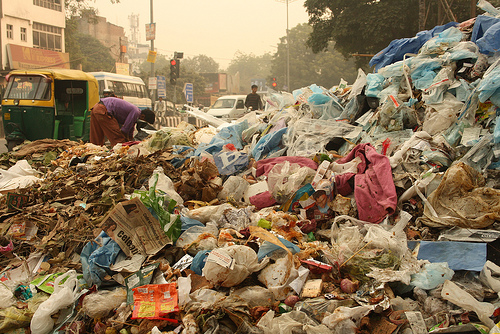
At the STEPS-JNU Symposium on ‘Exploring Pathways to Sustainability’ organised with the Centre for Studies in Science Policy (CSSP) at Jawaharlal Nehru University in Delhi, the first session explored the contexts and consequences of rapid urban growth in India through some in-depth case studies on urban waste management and agriculture. Rapid economic growth and growing inequality have created a growing informality, where hidden interactions, innovative activity and complex dynamics unfold. As Fiona Marshall from the STEPS Centre explained, this is a context that is poorly understood, and beyond the reach of formal institutions and policy.
Yet informality is central to economy and society in India. As panel discussant Kaveri Gill from Think Tank Initiative, International Development Research Centre, New Delhi, pointed out the ‘stylised fact’ that the informal sector disappears through development is a myth. As she argued: “This is not a transition. The informal sector is here to stay”, and that 80-90% of the economy of India really needs to be taken seriously. Yet most urban planning and policy efforts are focused on attempting to plan, control and regularise such activities – sometimes through state controls, at other times through liberalisation and handing over to the private sector.
The questions posed were: What is sustainability in this context? Should responses involve drawing such areas into the formal system or should such informality be built on? Among stakeholders the STEPS-JNU team had been engaging with there were clearly very diverse visions and pathways for development. Fiona Marshall urged the “recasting of the urban sustainability agenda, turning it on its head”.
Debates about the future of cities come together, she argued, in certain places: on the urban fringe, in peri-urban spaces – and around particular issues, notably those that cross-cut sectoral concerns, funding flows and policy domains, including issues of environmental health. The team’s research has pointed to what they term ‘flows of risk and opportunity’. Environmental and health issues are displaced from richer to poorer groups and from urban centres to peri-urban areas, yet the impacts often return in unseen and unexpected ways. Thus waste disposal is transferred to the urban fringe in massive landfill sites, yet the pollutants affect milk or vegetables produced in the same areas, imported to feed richer urban dwellers. These are hidden interactions around which there is little formal policy knowledge, and ones that are often invisible as they are carried on outside regulated frameworks, always informal and sometimes illegal. These flows are deeply affected by politics: of space and place, of class and social differences.
This is revealed perhaps most starkly in the case of solid waste management, a massive challenge in growing cities like Delhi. Pritpal Randhawa and Pravin Kushawaha from CSSP at JNU explained how certain powerful political and economic interests had constructed a particular pathway centred on the commericalisation of waste management and linking it energy production, especially through the construction of waste to energy plants. These are constructed as clean, efficient and environmentally sound. Yet these solutions exclude others, not least those who make their livelihoods from waste. Without recognition and official sanction wastepickers in Delhi are not seen as part of the solution. Ravi Agarwal of Toxics Link explained how in Delhi practices of recycling are barely mentioned and municipal authorities control waste management. The parallel informal system is almost completely overlooked. Dharmendra, a representative of wastepickers in Delhi, demanded access to waste in door to door collection, and explained how they are experimenting with collaborating with private sector operators.
As we heard in discussion, innovations in other Indian cities have begun to challenge this pattern, recognising the informal sector in the municipal response, as well as taking recycling seriously. As Chetan Vaidya from the School of Planning and Architecture, New Delhi, pointed out this went to the heart of urban governance challenges, particularly in the context of moves to decentralisation. In Bangalore change was brought about by a crisis, and the mobilisation of diverse actors that challenged the city authorities through the courts. This story is covered in a STEPS film – Bangalore: From Garden City to Garbage City -produced last year and supported by UKIERI.
Pathways to sustainability are thus generated by challenging structural power and interests – whether waste-to-energy investors, municipal authority laws or urban planning schemes – or by generating new discursive frames, bringing in knowledges and experiences of others outside the mainstream formal system. In discussion, Brian Wynne emphasised the importance of both dismantling and destruction of knowledge in creating new pathways, as well as building new knowledge through engagement with informal knowledges from those interstitial spaces outside the mainstream. As Lawrence Surendra, University of Mysore, argued, we need a new way of thinking about sustainability. “Things are happening on the ground, loops and exchanges are happening. Problems are being solved. Long before the formal institutions respond, before research can deliver”.
Wednesday, 6 November 2013
The Water Cookbook: Bhagwati Prasad’s strange and beautiful illustrations from peri-urban Delhi
by

I've just come across a copy of The Water Cookbook which I was given by Lyla Mehta, produced by part of our project looking at water conflicts in peri-urban Delhi. It's an amazing set of illustrations by Bhagwati Prasad of the Delhi-based research centre Sarai programme, which uses art and media to respond to and discuss urbanization.
The illustrations are a striking blend of surrealism, Hindu mythology and modern technology, placed in the book alongside short stories of everyday life in the city.
Copies of the book were given to some of the Delhi-based stakeholders involved in the project. It was published alongside a short film, photos and more traditional academic publications.


For larger versions, see our Flickr gallery of these images.
For more information about the research, see the Peri-urban project page.
Monday, 14 October 2013
New articles: Access to Water in peri-urban India
A new article examining the increasing inequalities around water provision in Delhi by STEPS Centre partner Alankar is published this week.
Socio-Spatial Situatedness and Access to Water (Economic & Political Weekly, October 12, 2013 vol xlviiI 54 no 41), looks at the social and political biases around large state-managed and institutionalised water provision in the city and the increasing gap between the haves and have-nots.
In the nearby Trans Hindon area, Alankar finds there are huge disparities in terms of formal and even informal water access. Both regions are seeing rising levels of deprivation among some and increasing affluence among others, reflected in the distribution and availability of water to these populations.
This project looked at water conflicts in areas on the edge of Delhi, to explore technological and environmental sustainability challenges in peri-urban areas where powerful actors benefit from the lack of regulation and marginalised people lack access to basic health, water and sanitation services.
Another article looking at this issue was recently published in the journal Geoforum by the co-convenor of the peri-urban project, Lyla Mehta, along with Jeremy Allouche, Alan Nichol and Anna Walnycki, Global environmental justice and the right to water: The case of peri-urban Cochabamba and Delhi.
By drawing on local people’s experiences and mobilisations around water in peri-urban localities in Bolivia and India, the article examines the contradictions around the implementation of the right to water in charged peri-urban spaces.
Socio-Spatial Situatedness and Access to Water (Economic & Political Weekly, October 12, 2013 vol xlviiI 54 no 41), looks at the social and political biases around large state-managed and institutionalised water provision in the city and the increasing gap between the haves and have-nots.
In the nearby Trans Hindon area, Alankar finds there are huge disparities in terms of formal and even informal water access. Both regions are seeing rising levels of deprivation among some and increasing affluence among others, reflected in the distribution and availability of water to these populations.
“This paper examines access to water in two geographic regions: Delhi and Trans Hindon area (THA) of the adjoining city of Ghaziabad. Contrary to public policy and new management strategies that derive from the notion of absolute scarcity, the paper argues that in the urban scenario of developing countries the “publicness” of public utility only gestures towards uniformity and universality. It actually reinforces the socio-economic inequities and disparities as these exist in current urban contexts.
“Thus, the paper tries to contextualise the meaning of socio-spatial situatedness as intertwined with the effective understanding of public utility. Although the term public connotes universal and to a large extent uniform service provisioning but as demonstrated in the following two area studies, the “publicness” of public utilities is restricted to middle- and upper-class citizens located in formal and planned enclaves. The numerically superior poor, situated in the densely populated informal, unauthorised and “illegal” spaces are either excluded from the utility’s services or remain largely underserved.”Alankar (alankarsy@gmail.com) was at the School of Environmental Studies, Jawaharlal Nehru University, New Delhi and worked with the STEPS Centre’s project Urbanisation in Asia: the peri-urban interface and sustainability of south Asian cities
This project looked at water conflicts in areas on the edge of Delhi, to explore technological and environmental sustainability challenges in peri-urban areas where powerful actors benefit from the lack of regulation and marginalised people lack access to basic health, water and sanitation services.
Another article looking at this issue was recently published in the journal Geoforum by the co-convenor of the peri-urban project, Lyla Mehta, along with Jeremy Allouche, Alan Nichol and Anna Walnycki, Global environmental justice and the right to water: The case of peri-urban Cochabamba and Delhi.
By drawing on local people’s experiences and mobilisations around water in peri-urban localities in Bolivia and India, the article examines the contradictions around the implementation of the right to water in charged peri-urban spaces.
“This article applies the global environmental justice (GEJ) approach to the problem of universal access to safe and potable water. Nowhere is the challenge more pressing than in peri-urban spaces where the lack of formal water provision and increasing environmental pollution lead to significant challenges for human wellbeing. We examine how and whether global discourses concerning the human right to water can be strengthened by resorting to GEJ, not least to allow for sustainable human–environmental interaction, in order to meet growing water needs in rapidly expanding urban areas.”
Subscribe to:
Posts (Atom)