Showing posts with label Ebola. Show all posts

Wednesday, 22 October 2014

Melissa Leach on Ebola & inequality – lecture text & audio

Some materials are now available from the recent Sussex Development Lecture on Equality, Sustainability, Security: Interlaced challenges in a global development era by former STEPS Director Melissa Leach. The text is available to download below as a PDF, and you can listen to Melissa's lecture online, courtesy of the Institute of Development Studies.

In the lecture, Melissa uses Ebola as a lens to look at how inequalities, unsustainability and insecurity can interact, enhanced by misguided interventions, to render people and places deeply vulnerable. Addressing these interactions must become central to a renewed vision of development for all.


Further reading
Ebola: difficult questions for development blogpost by Ian Scoones, 13 October 2014
Our resources on Ebola and other animal-to-human diseases

Wednesday, 15 October 2014

Ebola: difficult questions for development

ebolaAs the horrific Ebola crisis unfolds across West Africa, and the international community belatedly responds, there are some bigger questions that arise beyond the immediate challenges on the ground. These are worth raising and discussing, as they challenge our understanding of ‘development’ as framed and practised over the last few decades in fundamental ways.

The Ebola crisis has exposed the consequences of a pattern of systematic ‘underdevelopment’ or ‘structural violence’, and the implications of deep-seated unequal global relations. Yet poverty, inequality, conflict and unsustainability in poor, far-off places can usually be ignored. Pigeon-holed into suitable labels of ‘conflict prone’, ‘failed state’ or ‘weak governance’, development acts to displace such challenges. Yet viruses know no boundaries, and the threat of the Ebola outbreak has rung alarm bells far away in the seats of global economic and political power.

While much of the response is about control and containment, to avoid spread to richer more privileged settings, our attention must turn to why such outbreaks occur and have such devastating impacts in some places and not others. What responsibility does ‘development’, as practised in recent decades, have?

Unsettling questions are raised. We must ask whether the Ebola crisis is in large part the result of failed development, and indeed systematic underdevelopment and inequality entrenched by development policies imposed by western countries. For many years, West Africa has suffered the consequences of structural adjustment and economic reform pushed as a condition of aid. This has resulted in the hollowing out of states and the decimation of public services, including health systems. In poor countries in West Africa, this active neglect has surely been a contributory factor to the devastation being wreaked by Ebola. This in turn has been compounded by shifting service provision to the private sector and failing to train professionals and support state capacity in health and other services. This has resulted in an inability to spot and respond to the crisis, both in West Africa, but also internationally.

Zoonotic diseases such as Ebola initially emerge due to a complex combination of ecological, economic and social drivers. We don’t know the details of the recent Ebola emergence, but we must ask whether development policies have been part of the cause. For example, does an advocacy for private sector investment – in mining, large-scale agriculture and so on – result in forms of ecological and social dislocation and disruption that feed into such crises, facilitating spill-over and spread of disease? Complex ecological dynamics in forest-farm ecosystems may have resulted in changes of bat-human interactions causing the disease to spread. But again, we must ask whether environmental and land use policies have at least been in part a cause. For example, have our poor understandings of environmental and forest change, and the top-down interventions that have been promulgated by donors, NGOs and governments made things worse?

The most affected countries in West Africa have been subject to long-running conflicts. These have resulted in population movements, changes in social dynamics and deepening poverty. Development aid efforts have invested considerable sums in post-conflict ‘reconstruction’. But we must ask if much of this has missed the mark, failing to build social relations, community fabrics and institutions that provide the basis for effective responses to disease outbreaks, and the forms of resilience needed to weather crises. Reconstruction may have been only superficial, creating new forms of vulnerability to unexpected shocks such as Ebola.

Where growth has happened following conflict, it has been exceptionally uneven. Inequalities and vulnerabilities have risen. We must ask whether rapid urbanisation, precipitated by unequally distributed economic growth, has created new forms of vulnerability, especially for the poor. In the absence of urban planning and effective service provision due to inadequate state finances, the conditions for rapid spread of disease is set, exposing the most marginal to heightened risks.

In the last weeks we have seen a late rush to intervene in the Ebola crisis. Too often this has been without attention to the social and cultural logics that underpin local disease responses, and included a failure to involve local players. Some have argued that this could actually make matters worse, particularly for some social groups. This pattern replicates the past failings of development, rooted in a lack of understandings of root causes, structural drivers, and the complexity of local settings.
The Ebola crisis then poses some harsh questions. Has ‘development’ and the wider development business, including the research community in organisations like my own, been at fault, pushing failed development models based on poor understandings. Is ‘development’ in some ways culpable for the Ebola crisis?

The questions are multiple, troubling and profound. They also raise important challenges for the future of development. The Ebola crisis demonstrates how the development model of the last decades has failed; and indeed made matters worse, entrenching global, regional and local inequality, undermining sustainability and fuelling conflict. These conditions have led in part to the Ebola crisis.
Ebola is not the first major disease outbreak emerging out of conditions of structural poverty, political marginalisation and deep inequality, but it is perhaps the most dramatic in recent times, and acts to shine a spotlight on development failings as well as future challenges in the most stark of terms.

We must ask what are the alternatives that rebuild state capacity, draw on local community understandings and practices, and shift attention to reinforcing resilience in health systems, urban planning and land use?

Ideological positions and poor understandings have created a set of assumptions about development that are fundamentally challenged by the Ebola experience. Can this terrible crisis provide a moment for reframing development? Surely now is the time for a fundamental rethink of development approaches.

by Ian Scoones

This article first appeared on the Huffington Post.

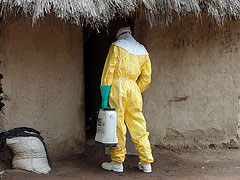
Photo: The fight against Ebola in West Africa by European Commission DG ECHO on Flickr. Published under a Creative Commons attribution-no derivatives licence.

Wednesday, 16 July 2014

Ebola: failures, flashpoints and focus

Annie Wilkinson
As the worst Ebola epidemic on record shows no signs of abating in West Africa, fear and ignorance are increasingly said to be playing a role in its continued spread. Meanwhile, local practices such as the consumption of bushmeat and deforestation are the go-to explanations for the epidemic's underlying causes. However, decades of anthropological research in the region by STEPS Centre and Institute of Development Studies (IDS) researchers, indicates not only that this picture is an over-simplification, but that disease control policies based on these ideas may be unhelpful.

The latest news from West Africa is troubling: outreach and surveillance officers have been attacked, rumours circulate that the disease does not exist, that medical staff are harvesting organs and anyone going to hospital will not come out alive. Tear gas was reportedly used to disperse a crowd at Sierra Leone’s Kenema Government Hospital who were demanding the release of family members admitted to the Ebola treatment centre there. As many as 57 patients are reported "missing" in the country, either fleeing treatment centres or avoiding them altogether. This seriously hinders contact tracing and infection control efforts.

Both the Sierra Leonean and Liberian presidents have said anyone obstructing suspected Ebola patients from receiving official treatment will be punished. But these announcements are unlikely to have much effect, being disengaged from the reasons behind the community suspicion and the complexities of the socio-cultural context.

An important lesson from early outbreaks in Central Africa was to include anthropologists in the response teams so that local knowledge could be used to strengthen control measures and minimise fear. Medecins Sans Frontieres (MSF) have been using anthropologists as part of their team in this current episode too, but the rumours are proving hard to beat. IDS Director and STEPS Centre former Director Professor Melissa Leach, has lived and worked in the region. MSF recently asked for her anthropological insights, so we at IDS and the STEPS Centre have been thinking about how to put the disease and responses to it in context.

Disease and health seeking
Even the most remote rural populations should not be assumed to be unfamiliar with concepts of modern medicine, however their engagement with them may be mediated by other logics. People are accepting of Western medicine but are ambivalent about the formal health system. The history of Lassa fever, another viral haemorrhagic disease which has been recognised as endemic in the area for decades, is relevant. During my doctoral research on Lassa fever I was told of longstanding rumours about medical staff administering lethal injections. Patients have been known to avoid the Lassa ward in Kenema.

Underlying health seeking patterns, is the fact that people hold multiple models for interpreting and responding to sickness. In Mende areas, there are general categories of big and small fever, and ordinary and hospital sick, as well as specific biomedical diseases. Lassa was classified a 'big fever' and Ebola may well be too. Diseases can be understood as caused by multiple things, including germ theory or 'witchcraft'. These causes are not necessarily mutually exclusive. A diagnostic test which 'proves' someone has an illness may not be viewed as conclusive. Key to understanding health seeking is to understand how disease categories shift as the illness progresses. The way people and those around them have behaved, the events leading up to the illness and circumstances surrounding its onset all influence the model which is applied and the treatment sought.

Death and 'secret' knowledge
Traditional burial practices have been implicated in transmission as they involve mourners having contact with the deceased infectious body. The importance of burial practices cannot be underestimated as they are strictly controlled by the male and female societies (known as 'secret societies' in English) who are central to local and regional politics. Medical teams wishing to prevent traditional burials will likely be intervening in domains of power and 'secret' knowledge that lie at the heart of the socio-political fabric which society officials control.

Secret knowledge, and membership of particular societies which offer access to that knowledge (to different degrees) characterises this region of West Africa. Much about the medical response may resonate with these themes: hiding patients behind screens (in isolation), wearing masks (protective clothing). It may be that medical teams are interpreted as another 'secret society'. Response teams should be sensitive to these possibilities and aware of why they may face resistance.

As with disease, there are multiple kinds and causes of death. Certain circumstances – such as sudden death or that of a pregnant woman – raise suspicion. 'Witchcraft' is the most frequently discussed but this confuses some distinct phenomena including malicious spirits, bad intent by sorcerers, and inappropriate behaviour. Such deaths may require special practices and again secret knowledge is likely to be important. This may be an additional reason why funerals are proving a flashpoint in this epidemic. It is possible that by not allowing the secret societies to carry out the appropriate cleansing after unusual deaths that medical teams are perceived to be making the situation worse.

Avoiding simple explanations: the need for a social science
While the recognition of Ebola in the area is new, people are likely to be interpreting and responding to it in line with longstanding local frameworks. Public behaviours and attitudes that might at first sight appear to reflect ignorance, can and should be seen as part of cultural logics that make sense given regional history, social institutions and experience.

Viewing conflicts as stemming from opposing categories of traditional and modern does not capture the complex and emergent meanings which define life in this region and this epidemic. This blog highlights only a small part of this, but it illustrates the need for a social science perspective. That perspective should also include examining the politics of knowledge which are at play. Simple narratives that blame the epidemic on local people for eating bushmeat and deforestation are already appearing. Prof. Leach has highlighted how these overlook well established patterns of land use and interaction with bat habits and so are unlikely to explain why the disease has emerged in West Africa now.

It is hard to say much with great certainty about Ebola, except that it is terrifying and tragic for those affected; all the more need for researchers, health workers, policy makers and the media to be cognisant of the power and politics involved in responding to and controlling the disease.

By Annie Wilkinson, post doctorate researcher, Institute of Development Studies

Find out more: