Showing posts with label environment. Show all posts

Wednesday, 5 November 2014

Political Ecology: resources, power and justice

With conceptual roots in political economy and cultural ecology, as well as close relationships with development studies and science and technology studies, the multidisciplinary field of political ecology shares a number of theoretical and methodological complementarities with the STEPS Centre’s pathways approach.

In early September 2014, the Lancaster Environment Centre at Lancaster University hosted an exciting workshop that brought together leading political ecologists from throughout the UK and Europe to discuss the state of the field of political ecology and explore promising new directions in field research and in conceptualising environment-society relations in a dynamic world.

The workshop, Political Ecology: Resources, Power, and Justice, featured a full day of doctoral research presentations followed by a second day of research talks by senior scholars in the field.

New questions and directions
The event addressed issues of longstanding significance in political ecology related to resource extraction, conservation, neoliberal natures, and social justice. New and renewed questions and directions emerged as well, for example around development-environment relationships and engagement.

Using research spanning the globe, key themes that emerged over the two-day event included securitisation and militarisation of conservation; the financialisation of nature, including the role of the state in securing control and brokering; ethics; land and resources; the politics of dispossession, belonging, and exclusion; labor and the production of environmental knowledge and value; conflicts, contradictions, and paradoxes in the politics of natural resources; and the role of technology in visualisation and value creation around resources and landscapes.

The PhD sessions engaged a number of topics ranging from the transformation of natural landscapes, livelihoods, and ecological imaginaries through processes of resource expropriation, visualisation, valuation, and marketisation, to conflicts and contradictions between goals of human development and biodiversity conservation, to the discursive space created through the politics of indigeneity.

Conservation and the War on Terror
In her keynote address, 'Environmental governance: from global markets to global security', Professor Rosaleen Duffy (SOAS, University of London) used conservation as an example to make the case that we have entered a new phase of environmental governance characterised by the intersection of neoliberal environmental governance and securitisation/militarisation, specifically linked to the imagery, crisis messages, and technology of the War on Terror.

The keynote was thematically complemented by Dr. Bram Büscher's presentation, which linked the historical intersectionality of race and landscape in South Africa with the contemporary "politics of hysteria" and role of social media in conservation related to the creation of a "space of exception" justifying green militarisation around rhino poaching in Kruger National Park.

Using the case of bioprospecting in Madagascar, conference co-organiser Dr. Ben Neimark discussed the role of scientific labor in producing commodities for green economic development. Neimark particularly highlighted the inequitable and subordinate role of Malagasy scientific labourers in the green economy that they help to produce.

One hallmark of an excellent conference is that attendees come away, not only with answered questions, enhanced knowledge, and clarified concepts, but invigorated by new questions and excitement about the future of the field and its engagements with important contemporary problems that will shape our shared social and environmental futures. In that sense, Political Ecology: Resources, Power, and Justice was thoroughly excellent.

Questions raised
Reflecting on two very busy days, some of the broad questions raised by the event include:
  • How do the themes, issues, methods and orientations represented at link up with and diverge from broader global trends in political ecology?
  • How do we best conceptualise and research environmental struggles and transformations in a world in which environmental governance is increasingly inscribed with market logic, bringing together global discourses around crisis, scarcity, and the market on one hand and place-based narratives of value and crisis on the other in processes of value-laden abstraction?
  • What are the implications possibilities of these processes for lived experience, for social justice, and for environmental futures?
Many thanks to the co-organizers Dr. John Childs and Dr. Ben Neimark, the Lancaster Environment Centre at Lancaster University, and the STEPS Centre.

Wednesday, 29 October 2014

Call for abstracts: Critical Perspectives on the Financialisation of Nature

A Call for Abstracts has been issued for a workshop in March 2015 on the financialisation of nature.
Dollar Butterfly: icosahedral (Flickr)

The workshop, aimed at doctoral and early-career researchers, is entitled Critical Perspectives on the Financialisation of Nature – Theory, Politics and Practice. It will be hosted by the the Sussex-based Centre for Global Political Economy and the STEPS Centre.

It will be a 1.5 day intensive workshop bringing together doctoral and early career researchers to discuss, theorise and critically reflect on the practical and political implications of the commodification, marketisation and financialisation of nature.

The workshop will take place at Sussex University on 19th-20th March 2015, and the deadline for abstracts is 5 December 2014.

Full details


Carbon markets in China, fishery bycatch offsetting in Canada, catastrophe bonds in the US, weather derivatives in Ethiopia, betting on species extinction such as Norwegian sharks…

These are just a few examples of the commodification, marketisation and financialisation of nature. In what ways can we best make sense of these developments? What practical, political and theoretical innovations will allow us to better understand them, engage with them and contest them?

We invite participants from any discipline to a 1.5 day intensive workshop bringing together doctoral and early career researchers to discuss, theorise and critically reflect on the practical and political implications of the commodification, marketisation and financialisation of nature. Papers should focus on questions including (but not limited to):
  • What are the challenges, contradictions and limits that arise from the creation of these new forms of market-based environmental products and services?
  • What are the new materialities and commodities of nature that are created through these novel forms of governance?
  • How do these processes change the way we relate to nature, govern nature, live in nature and indeed are governed by nature?
  • How does the marketisation or financialisation of nature relate to other forms of accumulation and the wider political economy?
  • What kinds of (new) power relations are (re)produced through the making of environmental markets, and what social and environmental justice issues are brought to light or develop in response to these (neoliberal?) phenomena?

Papers


Participants will be required to submit full papers in advance of the workshop and are expected to read each other's work beforehand to enable in-depth engagement with one another's arguments. The sessions will be chaired by academics working in the field who will also provide feedback on papers. Moreover, the workshop will bring together activists and academics for a panel discussion, reflecting on the interlinkages between activism and research on the financialisation of nature.

Timeline and practical arrangements

Please send abstracts of up to 300 words to FoNconference2015@sussex.ac.uk by December 5th, 2014. Successful applicants will be informed before December 31st. Full papers are expected by February 15th, 2015.

Registration is free and food will be provided. We have some funding for accommodation and travel for a limited number of doctoral researchers. Details about applying for this funding will be sent out once abstracts have been selected.


Friday, 22 August 2014

A Day with Argentina's 'Street Engineers'

By Adrian Smith
They take pride in what they do at the Reciclando Sueños co-operative. Situated in the La Matanza district of greater Buenos Aires, the workers describe themselves as cartoneros profesionales (professional recyclers) and ingenieros callejeros (street engineers). Whilst some in the city see waste picking as a lowly activity, these workers consider themselves to be providing a public service vital for the future sustainability of the city. In embryonic form, they are nurturing an important urban infrastructure from below.

The co-operative gathers the plastic waste that blows through the vast grid of Buenos Aires’ seemingly never-ending streets. The cartoneros form one of many co-operatives that have developed in the city over the years. Reciclando Sueños specialises in plastic materials. Only some of these have market value, sometimes very limited. So they are trying to find ways of adding value by developing processing techniques, and by experimenting with ways to reclaim a wider range of materials. It is in this grassroots innovation sense that they call themselves street engineers.

By Adrian Smith
So they have developed heating techniques to help separate, clean up, and concentrate different plastics. This, and other methods such as milling, help bulk up the materials and add value. But they have also been experimenting with the conversion of beer bottle labels into bricks suitable for construction, and which have acoustic and thermal insulating potential. The National Institute for Industrial Technology (INTI – Instituto Nacional de Tecnología Industrial) are testing the bricks for certification, but it is taking time to generate the knowledge in officially approved form. It can be tricky working with the bureaucratic procedures of research institutes. Any progress through the system works due to helpful connections with committed individuals within these organisations.

When visiting the co-operative, accompanying a group from the network for Engineering, Social Justice and Peace, it felt to me like the ideas, experimentation and commitment to developing material processing infrastructure in La Matanza was very distant and disconnected from some important research and innovation infrastructures. I wondered what a more dedicated and localised research and innovation infrastructure might look like, and how it could facilitate the creativity evident at the co-op. Even further away is the whole investment and production infrastructure that generates this plastic and, potentially, re-uses it.

By Adrian Smith
The only connection the co-operative currently has with production and consumption infrastructures is through the prices it takes for the materials reclaimed. In trying to boost the price they can get for a wider range of materials, the co-operative is innovating techniques for plastics recovery and reuse. But the processing insights generated by these self-identified street engineers are poorly served by this price mechanism. Until other providers identify the workers as innovative, then existing infrastructures will provide insufficient resources and poor development spaces for co-ops like this to play a more informative role in new urban infrastructure.

By Adrian Smith

Wednesday, 13 August 2014

Sustainable Development Goals: lessons from the ‘nexus’


As part of our engagement with the ‘nexus’ of food, water, energy and the environment, STEPS members will be participating in an Overseas Development Institute event on 11 September 2014.

The event Tackling trade-offs in the food-water-energy nexus: lessons for the SDGs features contributions former STEPS Director Melissa Leach and includes a contribution from our Water & Sanitation theme convenor Lyla Mehta.

The event will examine how certain developing countries have tackled the trade-offs inherent within the food-water-energy nexus, balancing environmental concerns with the need for development, and it will reflect on the importance of integrating across sectors for the implementation of the SDGs. New research conducted as part of ODI's Development Progress project will be discussed. For those who tweet, the hashtag is #envprogress.

Event page (ODI website)
 

Monday, 14 July 2014

A culture of extraction and exclusion: How philanthropy impoverishes the vulnerable


maintenance-zambia
Maintenance crew, Zambia by Merlin on Flickr (cc-by-nc-2.0)
Well-intentioned people the world over see transformation to green ways of doing as absolutely essential. Many argue that by switching to green ways of doing, we can have win-win situations in which we tackle both environmental degradation and poverty, through innovative projects and by conserving wild areas where there still exist.

Yet at the Green Economy in the South conference, which took place from 8-10 July in Dodoma, Tanzania, case study after case study has showed how the language and practices of switching to ‘green’ result in the extraction of resources from Africa to the North, from the poor to the wealthy, all under the guise of philanthropy and development. Processes funded by Northern development agencies, such as REDD+, result in capital accumulating more by dispossessing Africans, enclosing African land, and selling ecological services to the wealthy few who can afford the high price tag.
 
Mining: what counts as development?
In extractive industries like mining, despite using development language, Corporate Social Responsibility (CSR) programmes are problematic. For example, regarding mining companies in Zambia, Tomas Frederikson argued that while CSR models were changing to become more than just public relations exercises, and while CSR projects were ever more complex, employing many staff in development projects, projects were still counting and costing development in controversial ways.
 
For example, when mines build roads to improve transport to and from the mining area to enhance extractive activities, they declare this as development; when they upgrade airports to improve their own access to mining areas, this is called development; and when they build schools (but only for the children of their workers) or healthcare facilities (but only for workers and their families) this is also called development, despite the fact that these were not developments identified or chosen by the ‘recipient’ communities, nor necessarily benefitting them. So while they were being displaced from their land, the touted ‘developments’ of CSR never flowed to all the community members, thus ensuring that they are dispossessed with little compensation.
 
Hope and knowledge in Mtwara
In Tanzania, the newly discovered natural gas boon in Mtwara, is touted to create a ‘boom’ for local communities; the communities themselves have great expectations for this development, and for example, expect that at least one family member per household will be employed in the gas extraction project. Once the gas is extracted, the local community also expects that the power plant for generating electricity from the gas will be located in Mtwara.
 
However, as Nancy Rushohora pointed out, local communities are not aware of the likely disadvantages and challenges of natural gas extraction, such as adverse environmental impacts. Nevertheless,‘if extracting natural gas will not serve to benefit local communities, local communities feel it would be better not to extract the gas at all’, Rushohora said, and at this stage there is no clear explanation of nor legislation ensuring that benefits will accrue to the Mtwara people.
 
‘Revenue Sharing’ in Kilimanjaro
Similarly, as described by Hanne Svarstad, in Kilimanjaro National Park in Tanzania, which was extended to cover a greater area in 2005, communities were displaced by extending the conservancy without displaced communities having any guarantee of accruing benefits. However, the Kilimanjaro National Park is held up as a best practice model for other game farms and national parks, because they have undertaken ‘revenue sharing’ with displaced and surrounding communities.
 
Revenue sharing takes place through several ‘development projects’ like a project giving local communities goats; a calculation of how beneficial the goat project could be calculated that at the current rate of revenue sharing, it would take 17 years for every household to receive one goat. While development agencies and international conservation NGOs involved in the park call it a ‘triple win’ solution (winning for biodiversity, climate change mitigation, and poverty reduction), the main narrative of communities living around the park was one of exclusion, dissatisfaction with the lack of compensation for expropriation of previous commons, and lack of influence and consultation before land was expropriated.
 
The costs to local communities is more than 10 times higher than the benefits, so in this ‘best case’ scenario there is a marked lack of distributive justice. Despite donors and international NGO rhetoric being pro-people, there has been no effort to look for local solutions to environmental management, but only impositions from outside either from the state or from donors and conservation NGOs.
Limpopo: game theory
 
In the Greater Limpopo Conservancy, linking South Africa, Mozambique and Zimbabwe, Francis Massé explained how Mozambican communities are being forcibly removed from their land (albeit with some compensation), ostensibly in order to protect South African rhinos, but in practice to set up private game farms and game lodges for wealthy tourists in Mozambique.
 
This is argued to philanthropically benefit Mozambicans through the investment of private South African and other foreign countries in Mozambique, but the compensation paid to communities displaced by these processes nowhere nearly makes up for the loss of access to land (the main means by which they secure their livelihoods). Locals are also not even employed in these game farms, as once they have been displaced they are seen as colluding with rhino poachers by providing information about where the animals are, so it is seen as essential to exclude them from the land where they have lived for hundreds of generations.
 
The securitisation that typically goes along with the creation of conservation areas is escalated and extreme in the Greater Limpopo Conservancy as former apartheid security forces police the South African side of the border, and Mozambicans from far afield police the Mozambican side of the border. Displacing Mozambican citizens is argued to be the only strategy by which South African rhinos can feasibly be protected from Asian syndicates even though no poaching is taking place in Mozambique, and expanded conservancies are encouraged by conservation NGOs who argue such areas contribute to the green economy.
 
Exclusion in Indonesia
Outside Africa, for example in Indonesia, similar extractive processes are taking place, both in logging and mining industries. Peter Howson described how in international agency discourse the green economy is equated with ‘green growth’; he argued that this invites elite capture and makes exclusion almost inevitable, particularly when programmes such as REDD+ specifically sought private finance funding. He described exclusion as taking place on the level of regulation, force, markets and legitimation and suggested that ‘the uneven distribution of REDD+ benefits intersected with already existing intimate processes of exclusion’.
 
At the same time, however, Rini Astuti described how notions of indigeneity were being used to produce obedient conservation subjectivities among Bahaneis and on Bahanei forest land, where concessions were also being granted to mining companies. While Indonesia’s indigenous communities had disintegrated through Indonesia political processes, new processes of reclaiming indigeneity and reterritorialising Bahanei land were being supported by planning land use around carbon markets, thus resulting in a carbon marketisation of Bahanei land. By promising carbon payments through REDD+, indigenous REDD+ subjectivities were also be produced inscribing new sets of customary identities with new rules and new ideologies.
 
Financialising nature
In Costa Rica, Brett Matulis described how REDD+ programmes promoted by the World Bank are also leading to the financialisation of nature, by creating a direct link between ecosystem services “users” and “providers”, so that, for example, water users are taxed, but water polluters are not, and the biggest users receive more, improved ecosystem services, while the most needy receive poorer ecosystem services. These tariffs have mirrored existing inequalities in Costa Rica, perpetuating uneven conservation development because those most in need cannot afford to pay.
 
by Rebecca Pointer, Information and Communications Officer, Institute for Poverty, Land and Agrarian Studies (PLAAS)
 
The Green Economy in the South conference ran from 8-10 July in Dodoma, Tanzania. This post first appeared on the Green Economy in the South conference blog.

Friday, 6 June 2014

‘Negotiating Environmental Change’ now available as an e-book

negotThe 2003 book Negotiating Environmental Change: New Perspectives on Social Science, edited by STEPS director Ian Scoones, Melissa Leach (former director) and Frans Berkhout (Interim Director of Future Earth), has been released as an e-book, with chapters available in digital form from Edward Elgar Publishing.

The book includes an opening chapter by the editors, as well as a contribution by STEPS co-director Andy Stirling, writing on risk, uncertainty and precaution. Other chapters cover economics, deliberative democracy, governance, trade, business, technology and consumption.

To view the digital edition, readers will need to purchase it online, or access it via asubscription (for example via an institutional library).

Negotiating Environmental Change is also still available in print from the same publishers and bookshops.

Tuesday, 18 March 2014

More than just a “clean energy race”? BRICS invesment and innovation could lead the way on green transformation


By Adrian Ely

On the sidelines of the World Cup in Brazil this year, another competition will be the subject of conversation amongst the delegations attending this year’s BRICS summit, also in Brazil. Which of the ‘rising powers’ is winning the ‘clean energy race’?

The sixth summit meeting of the group known as the ‘BRICS’ (Brazil, Russia, India, China and South Africa) was recently postponed from March to July, which will have seen the culmination of a month of football, with the world’s eyes on Brazil.

The host nation chose Fuleco (a portmanteau of the words “Futebol” – football – and “Ecologia”) as the name of the tournament’s mascot. And ecological harmony is one of the messages that Brazil wants to present to the world. In line with its leadership at the Rio+20 conference last year, the country is now advocating more inclusive and environmentally-sustainable development.
And Brazil is not alone.

The clean energy race – who is investing more and innovating faster?

Countries across the OECD and the other BRICS are also dedicating significant resources and policy effort to eco-innovation and the transition to a green economy. This includes a move towards forms of energy generation that emit less carbon dioxide. In the green economy, countries theoretically compete on the basis of cheap, clean, low-carbon energy that drives low-impact industrial processes.

The Pew Charitable Trusts, a US-based non-profit research and public policy organisation, recently released an interesting factsheet advocating greater investment in this area (PDF) by the federal government. It argues that in comparison to competitors such as South Korea, Japan, the UK and Germany, the USA is investing a lower proportion of GDP on clean energy R&D.

Previous Pew reports have issued similar warnings, looking more broadly to investment across the G20. In 2012, Pew pointed to rapidly increasing investment in India, and, in 2013, China was reported to have assumed the leading global position as ‘epicenter of clean energy finance’.

BRICS leading the way on both global competitiveness and social experimentation

The focus is on the scale of expenditures on high-tech, capital-intensive approaches to low-carbon energy provision such as solar photovoltaic/ smart grid combinations and large-scale wind power, where intellectual property is a key driver of investment.

Chinese firms made up three of the top five solar photovoltaic (PV) manufacturers in a 2013 survey (PDF).

The top turbine manufacturers in India (Suzlon) and China (Goldwind) now compete as leaders in the emerging wind sector. These are fast-becoming the dominant trajectories of energy innovation, creating new leaders in the field and challenging the USA as the incumbent energy power. Innovation of this kind can be seen as an important contribution from the BRICS towards a ‘green economy’.

But beyond these dominant trajectories, BRICS countries are also experimenting with energy technologies that receive less attention by incumbent energy powers. The scale of hydropower in China (now a global leader) is – with wind – reducing its otherwise overwhelming dependence on coal, and two of the world’s three 10GW+ hydroelectricity plants involve BRICS countries.

Likewise, Brazil’s focus on low ‘net carbon’ sugar cane bioethanol (notwithstanding social problems associated with its production) presents an alternative to petroleum, the dominant energy source in transport.Away from these high-tech solutions, other approaches to a green economy are also flourishing. These may not entail the same levels of financial investment or bring similar opportunities for intellectual property licensing fees. But they serve other goals such as social inclusion and poverty alleviation that are high on the political agenda across many of the BRICS.

They include:
  • Social technologies (including small-scale, often community-led projects that serve both energy access and low carbon objectives), funded by – amongst others – Banco do Brasil.
  • Solar thermal technologies in China, supplying affordable water heating without requiring the kinds of complex smart grid infrastructure needed for distributed solar PV generation.
  • Incorporation of local innovations around biomass energy into government-supported programmes (such as those supported under the National Innovation Foundation in India)
The BRICS are therefore home to many more contributions to the green economy than those measured in $ invested (as a proportion of GDP), or by sales or new patents.

Diversity in innovation can lead to a wider, more profound green transformation

It is this diversity of forms of innovation – often neglected in green economy debates – that moves the simplistic idea of a ‘clean energy race’ towards possibilities for a wider and more profound transformation.

Such green transformations will require widespread experimentation, learning and innovation beyond the dominant trajectories, often reinforced by incumbent interests. The STEPS Centre’s New Manifesto on innovation, sustainability and development governments and the international community argues that much more attention should be paid to diversity, not only in strategic investments but also through policies that protect creative experimentation in diverse niches.

The BRICS have a key role to play in the global search for green transformations. They are already producing leading firms in some of the core green economy sectors that are emerging across the world. But, they also provide a wider diversity of technologies, new forms of organisation and new ways of living that together offer opportunities for greener and fairer futures.

Beyond single-track races, the emergence of the BRICS offers the opportunity for a broadening out of potential pathways to sustainability, not only following the trajectories of the leading (Western) multinationals but also fostering wider transformations by enabling important alternatives to flourish.

  • Who is Winning the Clean Energy Race is a series of annual reports published by The Pew Charitable Trusts

Dr Adrian Ely is Head of Impact and Engagement at the STEPS Centre, and is a lecturer with the Science and Technology Policy Research Unit (SPRU) at the University of Sussex.

This post was first published on the IDS Globalisation and Development blog

Friday, 31 January 2014

IDS seeks 3 new fellows in environmental change

The Institute of Development Studies is seeking to recruit up to three new researchers with international reputations for innovative interdisciplinary work broadly within the area of ‘Environmental Change’.

A particular concern is to understand the challenges posed by climate change, in interaction with other environmental and social changes, and options for climate resilient pathways in the context of increasingly complex development challenges. All three appointees will have a strong emphasis on the political economy and political ecology of human-environment interactions in developing and emerging economies. These are questions strongly associated with the STEPS Centre’s work.

Applicants should have a PhD in social science with a strong commitment to working across disciplines, including with the natural sciences (or very exceptionally, comparable research and practical experience) and an excellent research and publication record with experience and interest in bridging research with practice and policy.

A demonstrated capacity to work in a multidisciplinary team and highly creative and cutting-edge group of researchers, teachers and communicators and partners from a wide range of backgrounds is essential along with practical experience in the field.

Finally, it is vital that applicants demonstrate a track record of fundraising, obtaining grants, research awards and consultancies to allow them to pursue both independent and collaborative research.

Salary: £33,467 – £54k+ per annum, depending on experience
Closing Date: 19 February 2014 (10am)
Telephone interview: W/C 03 March 2014
Interview date: W/C 17 March 2014

OFFICIAL APPLICATION FORMS ONLY, CVs are not accepted. Please click on the links below for an application form and further information.

Tuesday, 10 December 2013

Grassroots innovations: special issue of ‘Global Environmental Change’


The latest issue of the research journal Global Environmental Change is dedicated to the topic of grassroots innovation for sustainability.

The special issue contains six original research articles which focus on the US and Europe, guest edited by Adrian Smith and Gill Seyfang. These articles were selected from papers presented at a research workshop held at Sussex University in May 2012. More information about the workshop and the special issue papers are provided in a research briefing.

The issue also includes an article co-authored by STEPS co-director Andy Stirling on dynamics and diversity in communal growing activities in the UK.

Local organic food systems and community energy are two of the examples covered in the papers, which aim to develop better understanding of the impacts, potential of these initiatives to achieve wider changes for sustainability. Other papers examine the historical development of wind power and car-sharing, community currencies, and community gardening groups.


Read the articles

Global Environmental Change Vol 23 (5): special issue on grassroots innovations for sustainability


Read the briefing

GI briefing 21: Constructing grassroots innovations for sustainability


More on this topic

  • Grassroots innovations: a collection of projects analysing grassroots innovations for sustainable development

Thursday, 24 October 2013

Living on the edge: Rethinking aid amidst complexity

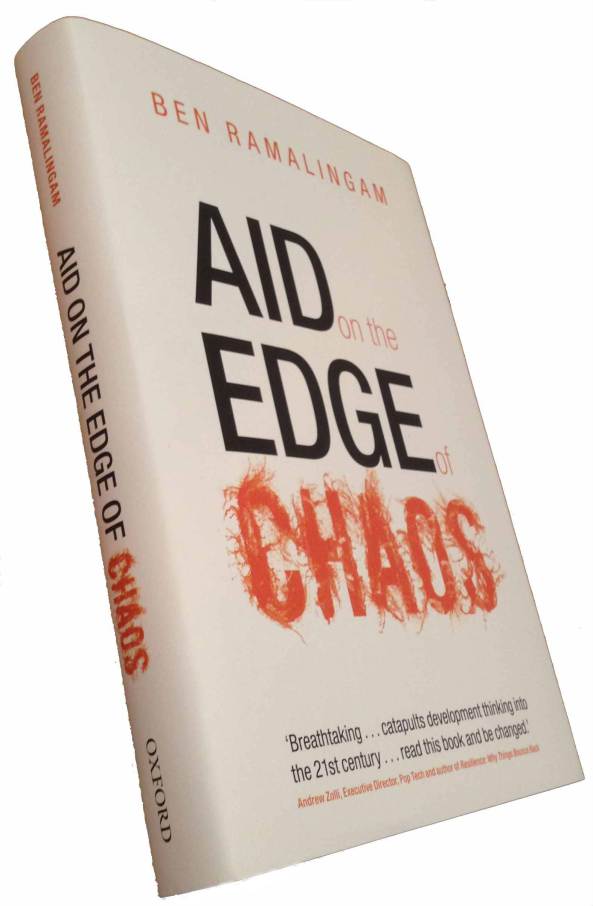
aid on the edge of chaosBy Melissa Leach, STEPS Centre Director

These days, a remarkably short and convenient flight takes one from Sussex UK -  where among other STEPS Centre activities this week I’ve been contributing to the post-2015 global sustainable development goals process and the international Future Earth Science Committee  – and Sierra Leone. Here, I’m on my way to join Njala University and Kenema Government Hospital colleagues and villagers in the country’s forested east, exploring the ecological and social processes shaping transmission and vulnerability to Lassa fever, a virus carried by rodents that routinely devastates lives and livelihoods here. This is one of the case studies within our Dynamic Drivers of Disease in Africa Consortium, an affiliated programme of the STEPS Centre exploring the interactions between people, environments and zoonotic disease.

This flight has passed particularly quickly as I’ve spent it riveted by a cover-to-cover read of  Ben Ramalingam’s fabulous new book, Aid on the Edge of Chaos. Published this week, it’s about how and why the conventional paradigms that dominate foreign aid aren’t fit for purpose in a world that is hugely dynamic, multiply-interconnected and replete with uncertainties; and how the approaches and tools of complex systems thinking can help trigger much needed transformations in how aid is conceived of, works, and is practised. The accolades on the cover are well-founded; this is a great read, engagingly written, and full of vivid examples, poignantly-funny cartoons and a reflective humility that suits its subject matter.

But it also strikes particular chords on this journey, since one of the book’s opening salvos is towards the Millennium Development Goals process, in its incarnation as a set of narrow targets and indicators that have driven ill-conceived planning approaches. And one of the key areas where it illustrates the power, value and practical application of new approaches is in the social-ecological dynamics of disease, where examples show complex systems thinking within integrated ‘ecohealth’ ’ approaches successfully tackling the challenges of malaria in Kenya, measles in Niger, and avian influenza in Asia.  The book traverses the scales – from the most global to the most local – and range of issues – from macro-economic, environmental, societal and political  concerns, to everyday health, livelihoods and agro-ecologies – that we regularly try to bridge in the STEPS Centre, and that I’m somewhat schizophrenically trying to cover this particular week. And it picks up on some of the self-same examples, albeit with a host more in between, offering insightful analyses of the global financial crisis, the Cuban missile crisis, humanitarianism and its misrepresentations of sexual violence in the Congo, and ‘hole in the wall’ computer technologies in Indian slums – to name but a few of the most memorable.

The book’s central argument, as I read it, is that development – as a broad process and normative project concerned with change towards improved human wellbeing – has been beset by a mismatch between the assumptions and practices of the foreign aid industry, and the way the world actually works. Aid, put simply, has been driven by mechanistic assumptions and planning models that assume predictable processes amenable to linear transformation. Particular modes of thinking, measuring and accounting, bureaucracies and institutions, and field-level action, aligned with such assumptions, tend to dominate, and prove remarkably resistant to challenge even when they lead to manifest failure to bring about the desired change, or even to make things worse. Instead, the reflex tends to be to ascribe problems to ‘implementation difficulties’ – or to blame the so-called beneficiaries. Analysing and exemplifying this self-reinforcing tendency to ‘try to do the wrong things righter’ as a pernicious feature of the ‘aid system’ in part 1, the rest of the book looks to ways to change it.

It looks specifically, and in a wonderfully wide-ranging and thorough sweep, at what the insights and tools of complexity thinking offer. Rather than reify this as a single science, complexity is aptly portrayed as an evolving work in progress, a diversely inhabited set of only partially explored territories. It encompasses perspectives emphasising open, dynamic, non-linear systems; emergence, learning, adaptation, self-organisation and co-evolution amongst multiple elements and agents, an emphasis on social and interpersonal relations and networks, and an understanding of change as non-linear. It involves a colourful cast of characters, thinkers and institutions, and a multiplying array of tools and methods, from agent-based modelling to network analysis. Having laid out this array, the book’s third part illustrates how these alternative understandings – grounded more in ecology than physics, anthropology than economistic rational choice – have underpinned and been mobilised in some very practical examples of different ways of thinking about and doing development, more workable in an intrinsically complex world.

The overall arguments here have much in common with the STEPS Centre’s pathways approach, which as Ben notes, has drawn on aspects of complexity thinking to track, identify and look to building pathways towards multiple, dynamic sustainabilities. This book’s detailed and specific insights into aspects of complexity science offer many points of engagement with and enrichment of STEPS Centre work, not just in relation to health and disease dynamics but also in climate change, energy, agriculture, water and in thinking about ‘green transformations’ more broadly, so I’m particularly delighted that Ben is now with the STEPS Centre as a Visiting Fellow for the next two years. The messages of this book – about the importance of diversity, fostering creativity and innovation at the margins, and humility – resonate very strongly with the STEPS Centre’s analysis and ethos.

In turn, pathways – as we explore them – also implicate questions of power and social (in)justice more fully than Aid on the Edge of Chaos explores. There are important debates to be had about the potential uses and abuses of power in the application of complexity science and its concepts, as well as their distributional implications, and I’m looking forward to these conversations. Equally, a pathways approach, conceived over longer historical timeframes and in relation to diverse and contested futures, might point to ways that narrowly and simplistically defined aid approaches have not just misconceived and thus acted ‘wrongly’ on real-world systems – causing collapses in Balinese rice farming in the 70s, for instance, or  enabling resurgences of malaria as parasites evolved to resist ‘silver bullet’ solutions – but have also become part of pathways, creatively appropriated, subverted or (re)directed by diverse local and national actors to suit their own goals, interests and narratives. These complex interactions between ‘aid’ systems/pathways, and diverse ‘real world’ systems/pathways, are challenging to study but well worth attending to, since they too may be a source of unexpected innovation and transformation.

So plenty of food for further thought, debate, analysis and action fuelled by this book. I’m looking forward to working with Ben and colleagues to thinking through the implications for big global and national development processes such as those around the post-2015 framework, and to working with colleagues on the Future Earth Science Committee to ensure that complexity thinking is properly reflected in the new, integrated, interdisciplinary science for sustainability that we are tasked with developing and promoting over the next decade.

But meanwhile, we’re about to land in Freetown – and the next week will be about seeking to understand complexity as lived and practised by the Mende villagers of Kenema district, as they grapple to secure health and livelihoods in rapidly-changing post-conflict farming and small-scale mining landscapes. Do their ideas, creativity and practices, amidst non-linear interactions between ecologies, rodents, people’s movements and social relations, offer clues as to how to limit Lassa fever and its effects? Might these contribute to forward-looking, integrated ‘one health’ and ‘ecohealth’ approaches, beyond the narrow lab-focused diagnostics and vaccine development that currently dominate? One of this book’s overriding messages – is that to improve development intervention, professionals need to see the world with new eyes. People who have been living and innovating with complexity at the margins all along, like the women and men of Sierra Leone’s forest villages, may turn out to be our best guides in such re-visualisation.