by Jeremy Allouche & Maria Cooper
Resource politics is coming back to the forefront of academic and
policy debates around peacebuilding. Environmental peace and state
building agendas are dominated by questions concerning informality and
hybridity in resources. What kind of role do service providers play in
peacebuilding and state building and what can we learn from service
providers in post conflict states?
In his chapter in a new book on Water and Peacebuilding,
Jeremy Allouche makes the case for paying attention to the role of
informal service providers, and actively working with them to improve
the transition from informal governance to state empowerment.
Resource politics is back. While recent conflicts should not make us
jump to dubious conclusions about ‘resource wars’, the management of
resources and their dividends is once again becoming an important
concern for the international community in relation to state building
and peacebuilding.
In peacebuilding, resources matter. In the ongoing Darfur conflict,
for example, important resources such as water are increasingly taken
into consideration in attempts to achieve peace and stability. Prominent
in the attempts to resolve the conflict in recent years has been the
Doha Document for Peace in Darfur
(DDPD), signed in 2011 by the Sudanese government and the rebel
Liberation and Justice Movement. It recognises the importance of
addressing multiple issues, as well as the interlinkages between
resource use, institutional reforms, state legitimacy, development and
economic growth. As such, resource politics is considered an essential
part of typical post-conflict restoration – ensuring that citizens’
needs are met and restarting economic activity.
Doubts about the success of the DDPD
are largely blamed on the Sudanese government hindering its
implementation, as well as its being supported by groups without the
necessary political and military influence to endorse it. Despite the
limited impact of the DDPD, the centrality of resource management to the
solution of the conflict still stands. A
recent UNEP report confirmed this by highlighting the importance of environmental governance in the process of peacebuilding.
Service delivery and state building
Restoring service delivery (or establishing it for the first time) is
an important part of the resource management so central to
peacebuilding. The economic benefits, in particular, of these
infrastructural developments are emphasised in many international
organisation narratives around post conflict reconstruction, as the
recent NEPAD conference in Senegal
shows. Donors also consider it a priority to address economic
deprivation, especially as it is such a determining factor of general
welfare and can in many cases be one of the underlying causes of the
conflict in the first place.
However, service delivery is not only about improving the economic
wellbeing of citizens. It can also play a significant role in state
building, including improving the authority, legitimacy and visibility
of the state and giving it a monopoly of power – for example, in
taxation.
Through providing services such as water, the state can enhance its
legitimacy in the eyes of its citizens as it improves their wellbeing.
It is also a nonviolent way for the state to penetrate into rural or
inaccessible areas, and gain a presence there.
How water links citizens to the state
An example of this can be observed in Zimbabwe following the
country’s independence in 1980. The Mugabe government prioritised
providing water and sanitation in rural areas whose inhabitants had been
central to the armed struggle that brought Mugabe’s party into power.
This increased the party’s popularity and legitimacy in the areas and a
majority of the rural communities felt that they had the same rights as
the urban elites. The service provision becomes a direct link between
citizens and the state.
Service delivery also strengthens the state’s authority and control.
The state can apply a uniform standard throughout its territory, meaning
that exchange and mobility is facilitated. In addition, it contributes
to equity, power-brokering and pacification as rival factions are
undermined. In this way, the strengthened state can accommodate former
rebels in positions of influence in public institutions to prevent them
from developing alternative centres of power.
What about informal providers?
The view outlined above is, however, a narrow vision of state
building which focuses on technical aspects of building state capacity,
and which ignores (for example) identity issues. This view sees the
state as centralised and securitised, emphasising state penetration and
the definition of boundaries. It also assumes that conflict is the
reason for the absence of the state provision of services.
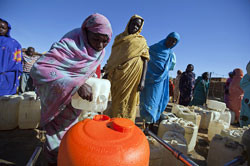
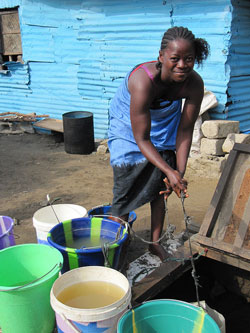
In many post-conflict situations, the dominant providers of water are
in fact non-state, informal providers. However, this might not be
caused by the conflict; it might be because formal national institutions
were poor or non-existent. In these situations, local communities and
households will have built up their own informal methods to ensure water
supply in the face of droughts, floods and other water-related risks.
This informal service delivery is often sub-standard and relatively
expensive. Nonetheless, in poor and peri-urban African communities,
unregulated, small-scale, informal water providers dominate the delivery
of water.
In fact, Western assumptions of the effects of conflict on
infrastructure are often wrong. Westerners often see conflict as a
highly technological battlefield, when in fact many post-colonial
countries are confronted with irregular warfare favouring indirect
approaches of targeting the enemy. This type of warfare means that large
elements of the infrastructure are left unharmed, and may continue to
be used by informal service providers in the absence of state provision.
Private sector participation in water services in post-conflict
situations is consequently very important.
When trying to build up formal structures and governance as part of
peacebuilding and state building priorities to increase water security,
it is important to take informal structures into account. Informal
structures are often all that people have. Introducing government
service delivery may actually damage the informal structures and affect
informal livelihoods in a way that decreases water security for people.
The perspective of informal service providers in the state building
discourse, then, becomes critical.
The bureaucratic model
Yet the predominant approach to state building we can see today
focuses on creating security and stability in order to control territory
and promote regional and international trade. State service delivery is
part of this, as it is considered a basis of the liberal peace model
approach often used by donors to improve citizens’ wellbeing and
enhancing state legitimacy. This leads to a centralised state and the
view that informal service providers are resisting state authority.
According to this model, informal providers are part of the problem, not
the solution.
The international community thus tends to act to build a particular
type of bureaucratic state emphasising depersonalised, formalised, and
rationalised political power. This conception of the state is dominated
by a Western
Weberian
discourse emphasising the role of strong bureaucracy and institutions.
Its influence over the state building agenda leads to a lack of
recognition of the informal service providers and the role they play in
post conflict situations.
The effect of this discourse is to disconnect the state building
agenda from the post-conflict reconstruction agenda. Informal service
provision, however, bridges the two. For example, providing water
services improves citizens’ lives and wellbeing, leading to a restart of
economic activity, etc., and other important aspects of reconstruction.
It is also an essential instrument for state building and improving
state legitimacy and authority: if the well-being of citizens is
improved, the legitimacy and authority of state institutions will be
increased.
The challenge of moving from informal to state governance
There is, however, a major challenge in reconciling informal and
conventional procedures of water provision. For example, regulating
non-state water providers is difficult, with limitations to contracts
and monitoring. The lack of recognition of informal service providers in
the state building discourse has far-reaching consequences for pricing
and public health. Informal service providers are able to charge very
high prices as they operate in conditions without competition, and water
quality is often left unchecked, leading to the spread of diseases.
Despite this, outside investments in the water sector in post-conflict situations are often considered too risky. A
report by the World Bank
shows that private investment in water supply tends to come much later
and be more limited than other investment in infrastructure.
Instead of seeing informal service providers as part of the problem
in post conflict reconstruction and state building, why aren’t they seen
as part of the solution? To do so, practitioners and analysts of state
building should open up the state building discourse, and talk about how
to move from informal governance to regulatory governance.
The difficult part of all this is how to build up institutional
capacity, which is essentially formal (‘top-down’), without harming the
informal (‘bottom-up’) systems that already exist, and upon which many
citizens still rely for their water provision and livelihoods. There
needs to be a productive balance between formal and informal service
delivery and water governance mechanisms.
The transition from informal to formal governance needs to receive
more attention in the state building discourse, in order to develop a
balanced and nuanced understanding of the ways in which informal and
formal services can be supported in parallel, in a context-sensitive
manner, to increase water security, improve citizens’ wellbeing and
ultimately contribute to peacebuilding.
Further reading on water & justice

 This news roundup has been collected on behalf of the China and Brazil in African Agriculture (CBAA) project.