Between 13 and 15 October the Open and Collaborative Science in Development Network held its first workshop in Nairobi. The objective of the workshop, organized and funded by the Canadian International Development Research Centre, and supported by the University of Toronto and Kenya iHUB, was to kick-start the construction of a research network to promote 'open science' for the Global South.
This initiative arises in a context where open science has become a buzzword for large foundations such as the Bill and Melinda Gates Foundation and development institutions internationally. In the midst of so much interest, the inevitable question is whether open science can live up to its promises. In this spirit we went to Kenya to learn about and discuss the issue.
STEPS América Latina was privileged to be amongst 14 other institutions whose proposals had been pre-selected (from over 90 applications) by OCSDnet. Participants came from Argentina, Brazil, Costa Rica, Jamaica, Canada, India, Kenya, South Africa, Lebanon, Kyrgyzstan and Thailand. Co-ordinated by Leslie Chan, from the University of Toronto the workshop also included a set of international advisors including Lidia Brito, Hebe Vessuri, Cameron Neylon, Apiwat Ratanawaraha, Matthew Todd and Kaitlin Thaney, representing the Science Lab of the Mozilla Foundation.
If, before the event, a number of elements – the meeting venue, the novelty of the subject, and the excellent background paper – suggested a rewarding and challenging encounter, it rapidly became clear that the event would exceed our expectations. In part this was because the workshop brought together a truly interdisciplinary group of anthropologists, chemists, biologists, lawyers, geographers, ecologists, engineers, experts in social development, forest conservation and sociologists who all shared an interest in the production of open and collaborative knowledge.
In most cases, the participants also had practical experience of the development and use of participatory tools for the collection, management and dissemination of scientific evidence in relation to social or environmental issues. As such, we discussed projects that sought to expand access to scientific databases on botany, foster public control over the emission of gaseous pollutants in urban areas, study the asymmetries of power in cases of indigenous intellectual property, and support the construction of laboratories of open hardware in order to study water contamination, amongst other examples.
Creating dialogue amongst such a heterogeneous set of disciplines, development issues and geographical situations sometimes proved challenging. Of course, there were several moments “lost in translation” (especially between scientists and the few sociologists who participated in the meeting). And yet, the workshop enabled us to explore a rich variety of definitions and interpretations of what it means to do open science (and open innovation).
We cannot summarize here the different points of view aired within the workshop, and interpretations of the event. But if it is interesting to note that it became clear, during the three days, that the notion of open science is intertwined with the collaborative and iconoclastic spirit of the communities of open software and open hardware (along with the hacker and maker movements), the history of grassroots innovation movements, the experiences of Science Shops in Europe and North America and, closer to Latin America, the tradition of participatory action research. All these movements not only share some history with open science, but they also help to form a central aspect of its definition: the search for the democratization of knowledge.
A second issue highlighted during the discussions in Nairobi is the importance of information technology tools for data collection, visualization and communication for the practice of open science. Incorporating these tools is a challenge and a necessity in order to establish ways to collaborate that are open and accessible to the largest number of participants possible.
In the context of increasing interest and discussion of the potential and uses of open science to address major development challenges – for example in research initiatives for orphan diseases – an analysis of the history, diversity and uses of open science practices is more than welcome. It’s also likely that reflection on the notion of open science and citizen participation in the production of knowledge allows us to shed some light on other current topics of innovation and development, as in the cases of research into innovation for social inclusion, and of the tensions between public research and policies for the private commercialization of knowledge.
Of course, there are still more questions than answers. For example: Is it possible to use methodologies of open science for research on issues that are neglected or rejected by dominant institutions of science and technology? In what ways can citizen participation contribute to the collection and validation of evidence on climate change and/or biodiversity loss? In what ways might mechanisms of participatory design and innovation accelerate the development of technologies for social inclusion?
It is difficult to know even if experimentation with forms of open science will be able to help address the growing problems of access and democratization of knowledge about the challenges of inclusive and sustainable development. The OCSDnet initiative certainly contributes to broaden the discussion, and connect the different visions, methods and tools in different regions of the global South. For now, it has given us an excellent reason to investigate the issue, and try to understand different experiences of open and collaborative knowledge production in Argentina and the region.
Find our more about STEPS America Latina
Media coverage of the most recent seminar in the STEPS America Latina’s series: Los nuevos senderos que se abren, Pagina 12
By Mariano Fressoli, STEPS America Latina

Showing posts with label science communication. Show all posts
Showing posts with label science communication. Show all posts
Thursday, 30 October 2014
Monday, 28 April 2014
'African Farmer': more than just a game

But whose vision should this be? How can risk and uncertainty be dealt with effectively? How can issues of gender, equity and social inclusion be taken into consideration in the design and implementation of these new initiatives? How can the ‘hardware’ of agricultural science and technology be linked to the ‘software’ of more democratic and effective institutions and policy processes? How should new investments in agricultural research and development be governed so that they benefit smallholder women and men farmers, who represent the vast majority of Africa’s agricultural producers?
While reflecting on these questions, I recognised that my colleagues and I could conduct new research, write more papers and books and share our findings and recommendations with development professionals and decision-makers in Africa and elsewhere, but these were unlikely to provide the kinds of insights that would confront their biases and raise awareness about the real opportunities and challenges facing Africa’s small farmers. Instead, I thought, ‘What if we tried something radically different, something that was both highly entertaining and deeply compelling, something that drew people in and allowed them to experience (vicariously, at least) the trade-offs and challenges faced by Africa’s producers on a daily basis? A computer-based simulation, perhaps?’
These insights led me to seek out collaborators in the Department of Informatics at the University of Sussex – Judith Good, Jim Jackson and Ellie Martin – to help design and develop a new computer game that would simulate farmer decision-making under uncertainty: the African Farmer Game.
Now, after more than three years of development and testing and with the generous support of the UK Department of International Development (DFID) and the UK Economic and Social Research Council (ESRC), it gives me great pleasure to announce that we have created two versions of African Farmer: a single-player version that can be played on a laptop or desktop computer, and a multi-player game that requires a group of players and a Game Manager.
 |
| Playing the game at the Institute of Development Studies, March 2014 |
The main aim of African Farmer is to bring alive to participants what life is like for a small farmer living in a rapidly changing society in a risk-prone environment. The simulation demonstrates clearly the complexity of decision-making, even in a simplified model of an agricultural society, and helps sensitise players to the impact of agrarian change from the small farmer's point of view.
Each participant is provided with land, labour and agricultural inputs to represent a family's farm and its resources. Each farmer makes her or his own decisions about the pattern of farming and level of investment in seeds, fertiliser and other key inputs. Faced with an uncertain social and physical environment, the participants go through seasonal cycles of production, feeding their families, selling or storing any surplus crops, and purchasing and applying new resources. They experience the constraints under which small farmers in the real world must operate.

Some discover that with the necessary investments and some good fortune they can get ahead, while others who encounter economic, social or physical shocks and stresses soon realise that short-term survival (of themselves and their families) can outweigh long-term plans and ambitions.
Both versions of African Farmer Game take players on a journey. They might start the game with clear ideas about the ‘right’ farming strategy and committed to educating their children but soon find themselves confounded by circumstances. Can they really afford to send their children to school when labour is so scarce and the payback is so far into the future? Should they honour an agreement to repay a loan to a neighbour when it means their child will die from malnutrition? The risk calculus and ethical landscape is often significantly different from what they imagined. The game aims to help players see things from the ‘inside’ (from the perspective of a small farmer with limited means and pressing concerns), to understand that what may seem obvious or right from the ‘outside’, may not actually be the best option, or indeed possible, for those living in the situation.
Our initial target audiences for African Farmer are senior undergraduate and graduate students and development professionals working in universities, research institutes, NGOs and international organisations who are working on agriculture and rural development issues. However, we believe there is also potential to expand the scope of the game to non-specialists, as it is much less about the technical aspects of African agriculture and much more about responding to uncertainty, dealing with complex trade-offs and making decisions with incomplete knowledge and serious resource constraints, a common set of challenges that poor people face everywhere.
I invite you to download both versions and the associate software and guides and to try them for yourself – and with your students and colleagues. As you will see, the objective of African Farmer is not to ‘win’ a prize or gain points as in traditional computer games. There is no one right way to play the game or to ‘win’. There is a multiplicity of goals that players can pursue – agricultural, nutritional, financial and social. Whatever your goals may be, I hope you will discover that we have created a computer-based simulation that is challenging, engaging and inspiring in equal measure. I would welcome your reactions to the game and your contributions to its continuing development and improvement.
By John Thompson
Dr John Thompson is Project Coordinator of The African Farmer Game. He is Research Fellow in Knowledge, Technology and Society at the Institute of Development Studies, UK, where he serves as Regional Coordinator of the Future Agricultures Consortium and Food and Agriculture Convenor of the ESRC STEPS Centre.

Tuesday, 18 March 2014
STEPS-JNU Symposium 2014: Powerful storytelling
The power of simple storytelling to move and inspire is explored in a new post about ‘photovoice’ by Julia Day, STEPS Centre Deputy Director and Head of Communications, written for the WonkComms blog.
Photovoice, a participatory method using photography and people talking about their experiences, is being used to great effect by our partner Shibaji Bose, a communications specialist at the Indian Institute of Health Management Research (IIHMR) in Kolkata, for the STEPS Centre’s Uncertainty from Below project.
At the recent Jawaharlal Nehru University-STEPS Centre joint Symposium on Exploring Pathways to Sustainability, Shibaji’s ‘Uncertainty through the Lens’ presentation about people’s experiences of living with climate change in three sites across India caught the imagination of delegates and earned high praise as the most powerful moment of the event.
In her WonkComms blogpost, Julia suggests researchers and research communicators alike might find a powerful focus for their work in back-to-basics storytelling.
Photovoice, a participatory method using photography and people talking about their experiences, is being used to great effect by our partner Shibaji Bose, a communications specialist at the Indian Institute of Health Management Research (IIHMR) in Kolkata, for the STEPS Centre’s Uncertainty from Below project.
At the recent Jawaharlal Nehru University-STEPS Centre joint Symposium on Exploring Pathways to Sustainability, Shibaji’s ‘Uncertainty through the Lens’ presentation about people’s experiences of living with climate change in three sites across India caught the imagination of delegates and earned high praise as the most powerful moment of the event.
In her WonkComms blogpost, Julia suggests researchers and research communicators alike might find a powerful focus for their work in back-to-basics storytelling.
Monday, 25 November 2013
Why we should embrace different stories in sustainability

I’ve recently got back from the Communicate conference where I talked about stories using examples from the STEPS Centre’s projects (see previous post). The conference strapline was “Stories for Change”, which taps into a growing awareness of the competing stories we tell ourselves – and each other – about people and nature.
Framing the theme around storytelling allowed us to explore three distinct but related questions:
- first, what to learn from individual stories about people’s relationship with the environment (from a community project in Kent to an encounter of flooding in the West Country);
- second, the lessons of campaigns or efforts to communicate about conservation;
- and third, more critical questions about what stories are and how they are used, our responsibilities as storytellers or listeners, and which stories about sustainability become dominant, why and with what consequences.
To put it simply: since powerful stories can themselves prop up power, looking at and questioning different stories (ways of seeing the world, the words we use to describe things, the terms chosen to frame particular decisions) is an important part of seeking alternative pathways to sustainability. I talked about ‘big stories’ and ‘little stories’ as a way of introducing the idea of power, of asking how past and future visions from poor and marginalised communities can challenge the big narratives that hold sway. Sustainability should be for the people, by the people.
With this in mind, ‘environmental’ questions are interesting because they can be approached from so many angles and perspectives. Which wording, positioning and moral framework you commit to are all open to debate, or should be.
Diverse views of biodiversity
There were a couple of examples at Communicate that brought this home to me.
First, a project by Simon Christmas for Defra looked at how people understand variety in nature. People are able to hold conflicting views about the variety of nature at the same time – for example, that ‘Nature will find a way’ (return to balance after shocks), and that ‘Nature can’t catch up’ (that humanity is damaging Nature too rapidly for it to recover) – depending on the timescale in question. In the short term, nature can’t catch up – but in the long term, it will recover.
But what is Nature – how separate are we from it? Some interviewees in the Defra project started out defining nature as a pristine wilderness, but then admitted that, in the UK at least, such a wilderness is virtually non-existent. People’s understanding of their environment (including urban enviromment) is subjective and fuzzy, and affected through experiences and activity – from walking the dog to bird watching or bug hunting.
Branding vs. politics?
So if everyone has different views of nature, how can campaigners seek to mobilise concern and action among different public groups?
Ed Gillespie, the conference chair, described the process of creating a ‘brand’ for the United Nations Decade on Biodiversity. What does it mean to ‘brand’ biodiversity, though? Branding is about emotion – it’s all about distilling the vision of a particular influential actor into an identity that aims to connect with people’s feelings.
But if biodiversity means different things to different people, and responses to it are inevitably plural and political, what happens when it gets branded? Don’t birdwatchers, say, have a different take on the issue from people who rely on forests for their livelihoods?
In other words, what does branding do to the ‘little stories’? Is it possible to incorporate branding into a process where little stories are given due attention and alternatives are possible? This is a difficult challenge, but in a world where brands are increasingly valued as a way of mobilising people towards environmental and social responsibility, I think this question deserves attention.
Looking at contrasting and conflicting stories opens our eyes to the political nature of science. First of all, this means looking at the content of stories themselves, and noticing what makes them different. But also: who’s telling them, why and what power dynamics exist to make some stories bigger than others.
A world within a woodland in Kent
The other example was a great story from a community in Kent that had seen chronic damage to a local woodland by fly-tippers and off-road drivers.
A group of residents decided to join together to repair the paths, clear rubbish and limit access (though not completely ban it) by off-road vehicles.
There is so much in this story. The contested claims over the woodland involved more than just local residents and fly-tippers or off-roaders. Parcels of woodland had been sold into private ownership and the details of owners and rights were unclear and hard to access. And local politics – the interest of an influential politician – was influential in kickstarting the project, as well as the determination of the local people involved in fundraising and in enlisting the help of the local Royal Engineers, local landowners, and others. But even after some hard work had already been done, the campaigners were dismayed when the National Grid cut a large band of woodland down to clear the way for power lines. A campaign on Facebook drew attention from further afield. One of the fly-tippers was also a landowner. The story does not end there – this is now being used as a case study to inspire other communities to take action.
At the centre of this story are questions over who has access to woodland, what it is for, how it should be used, the dynamics of ownership and land rights, and the roles that can be played by external agencies (politicians, local government officials, the National Grid, and helpful partners). The X Factor in all this may be confidence: the ability to think “I have the right to do something with this land, it belongs to me” and assert a claim over it, which will not always go unchallenged. What gives people the confidence to take action may be influenced by class, access to funding, access to helpful politicians and so on.
What do these stories about stories tell us? Since ‘environment’ is what’s around us, describing problems as ‘environmental’ inevitably carries a (hidden or obvious) ‘us’. But who ‘we’ are depends on where you look.
So we need to find ways to address injustice and inequality when we try to move towards sustainable futures.
Stories for change?
The STEPS Centre’s book Dynamic Sustainabilities has a section (p. 132-136) suggesting strategies to effect policy change, under five headings (the bits in brackets are my notes/explanations).
- Telling persuasive stories (highlighting alternative stories, ‘little stories’ if you like which suggest how institutions and governance might change)
- Building networks and encouraging champions of change
- Encouraging reflexivity (in other words, encouraging policy makers to look at the situation on the ground or reflect critically on the policy process itself)
- Opportunity, flexibility and adaptive governance (including taking advantage of a crisis, or big events like a change of government, to promote change)
- Building new skills and professionals (crossing boundaries between natural and social science, and between people who focus on local or macro scales, for example)
‘Little stories’ not only show big stories up, they can be a way to represent marginal or less powerful interests. But they are part of a bigger picture too, working within institutions, governance, power networks and social and technological change.
The idea of big stories and little stories seemed to get a good response at Communicate, but it clearly leaves a lot out – it’s one part of a bigger conversation. I’d be interested to hear other people’s views on other ways to illustrate these complex ideas.
Photo: Bee carving by nathanoxley on Flickr
This post first appeared on the STEPS Centre blog.
Monday, 18 November 2013
Big stories, little stories
by
This is the (slightly edited) text of my talk at Communicate 2013, in a session called “liberating stories”. The pictures are some of the slides I used. The brief was to provide some suggestions about the role of the social sciences in ‘liberating stories’ for environmental communicators, through memorable examples. I only had 10 minutes so had to simplify a lot of things, but I’ve provided links in the text below, which you can follow to read about the proper, full description of the research and its findings.
We use big stories to make sense of a world that is increasingly complex and changing very fast and where everything seems to be chaotic. The climate’s changing, we need to feed more people than ever, demand for electricity is growing massively. And I think sometimes big stories are used to reassure people that someone’s in charge.
So we’re told we need to ‘tackle climate change’ by giving huge areas of land over to biofuels, or that questioning GM crops is ‘anti-science’ or ‘anti-progress’, or that large-scale industrial agriculture is the way to feed the world, and so on, and so on, and so on. There is a certain type of powerful story that likes you to think that it’s not a story at all.
When we hear these big stories being repeated as fact, when sustainability is just presented as a technical issue, or a scientific problem to be solved by experts, I think a massive alarm bell should ring. A sustainability klaxon, if you like.

I am interested in how we can tell different stories – little stories – that can challenge some of these assumptions about the way the world should be.
The STEPS Centre does this by working with poor and marginalised people in developing countries and looking at the different possible futures that they can see for themselves.
There’s a STEPS project which looked at people on the edge of Delhi in India, in an industrial town called Ghaziabad that’s changed a lot in a very short space of time. The problem there is poor people are not getting access to water, or to clean water.
So the big official story in Delhi is the government is providing ‘access for all’ in the context of scarce water supply.
Through the research you see there’s a spider’s web of agencies that are supposed to deal with this. The problem is they don’t work together well, they’re not equipped to deal with things like inequality, informality and rapid change, as well as corruption and politics.
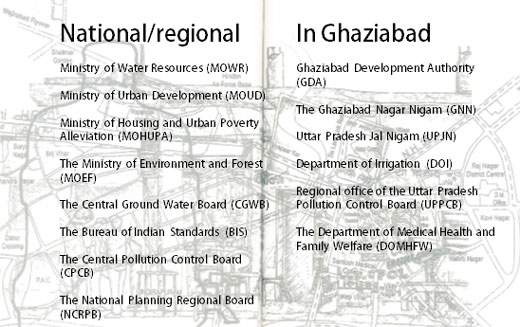
So you get this situation where there might be a massive water pipe running right through a poor area which might not even be on the map, on the way to the middle-class areas. People are having to run across a railway to get to the nearest pump and getting hurt.
So what about the little stories here?
There’s the ingenuity of people illegally tapping the water supply, building their own DIY irrigation systems. But there’s also pollution and illness. And also a lot of everyday life revolves around water, and there’s also a whole set of beliefs and stories about water as well – for example, it’s central to the mythology of various religions.
So exposing the big story and telling these little stories creates a disruption, so it’s easier to put your finger on what the problem is and start doing something about it. So in this project we used film and photos, and a mini-graphic novel as well as more traditional research publications to tell these stories.
I love this description about the task of sociology of scientific knowledge (SSK) by Prof Sheila Jasanoff: “to render more visible the connections and the unseen patterns that modern societies have taken pains to conceal”. There’s the idea that it’s actually quite important for those in power to try and disguise certain stories and certain connections – to pretend that they don’t exist.
What is it for example, about the story of inevitable progress towards large-scale industrial agriculture, enhanced by biotechnology and supported by corporate investment, that makes it such an attractive solution for agricultural development in Africa, and who wins and who loses from this story?
What our project did was go to some small farmers in a very dry region called Sakai, where they farm maize, and we listened to their stories and looked at how they actually make choices about which seeds or crops to use, how that fits with their daily life.
We used a technique called Multi Criteria Mapping to identify the farmers’ criteria for making their choices, like how important is the cost of seed, vs. how important is cooking, for your selection of crop. And we asked them to think about what they could do differently in response to all these droughts, and to rank the different futures that they imagined for themselves.
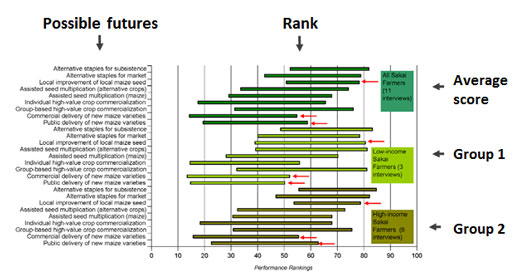
And then we compared this data from the small farmers, we compared it to what lots of other different groups thought the farmers should be doing – seed companies, scientists, policy makers etc. and what they thought the criteria were. And the stories were different, the little stories started to challenge the bigger story that everyone thought was obvious.
There’s a new section on the STEPS website all about methods which will explain how it works in more detail, and explains some other methods too.
Stories don’t operate in a vacuum. These big stories are swimming in a sea of institutions and social and environmental change, shaped by politics and power. So in this context telling a different story is a profoundly political act.
When we see these big stories we need to look at who is winning and losing, we need to broaden out the debate about the future to include more people, more kinds of knowledge. It’s not only more fun and more interesting, I think you get a better result.
This is the (slightly edited) text of my talk at Communicate 2013, in a session called “liberating stories”. The pictures are some of the slides I used. The brief was to provide some suggestions about the role of the social sciences in ‘liberating stories’ for environmental communicators, through memorable examples. I only had 10 minutes so had to simplify a lot of things, but I’ve provided links in the text below, which you can follow to read about the proper, full description of the research and its findings.
We use big stories to make sense of a world that is increasingly complex and changing very fast and where everything seems to be chaotic. The climate’s changing, we need to feed more people than ever, demand for electricity is growing massively. And I think sometimes big stories are used to reassure people that someone’s in charge.
So we’re told we need to ‘tackle climate change’ by giving huge areas of land over to biofuels, or that questioning GM crops is ‘anti-science’ or ‘anti-progress’, or that large-scale industrial agriculture is the way to feed the world, and so on, and so on, and so on. There is a certain type of powerful story that likes you to think that it’s not a story at all.
When we hear these big stories being repeated as fact, when sustainability is just presented as a technical issue, or a scientific problem to be solved by experts, I think a massive alarm bell should ring. A sustainability klaxon, if you like.
I am interested in how we can tell different stories – little stories – that can challenge some of these assumptions about the way the world should be.
The STEPS Centre does this by working with poor and marginalised people in developing countries and looking at the different possible futures that they can see for themselves.
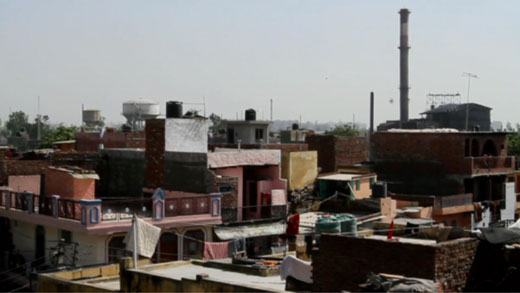 Water in peri-urban in India
There’s a STEPS project which looked at people on the edge of Delhi in India, in an industrial town called Ghaziabad that’s changed a lot in a very short space of time. The problem there is poor people are not getting access to water, or to clean water.So the big official story in Delhi is the government is providing ‘access for all’ in the context of scarce water supply.
Through the research you see there’s a spider’s web of agencies that are supposed to deal with this. The problem is they don’t work together well, they’re not equipped to deal with things like inequality, informality and rapid change, as well as corruption and politics.
So you get this situation where there might be a massive water pipe running right through a poor area which might not even be on the map, on the way to the middle-class areas. People are having to run across a railway to get to the nearest pump and getting hurt.
So what about the little stories here?
There’s the ingenuity of people illegally tapping the water supply, building their own DIY irrigation systems. But there’s also pollution and illness. And also a lot of everyday life revolves around water, and there’s also a whole set of beliefs and stories about water as well – for example, it’s central to the mythology of various religions.
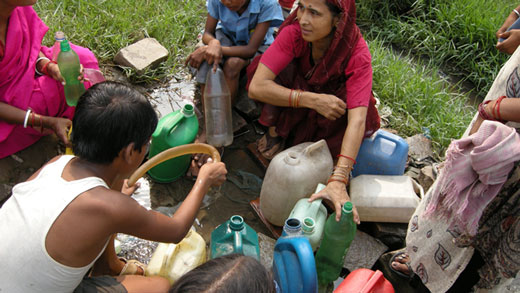 |
| Photo: Pritpal Randhawa |
So exposing the big story and telling these little stories creates a disruption, so it’s easier to put your finger on what the problem is and start doing something about it. So in this project we used film and photos, and a mini-graphic novel as well as more traditional research publications to tell these stories.
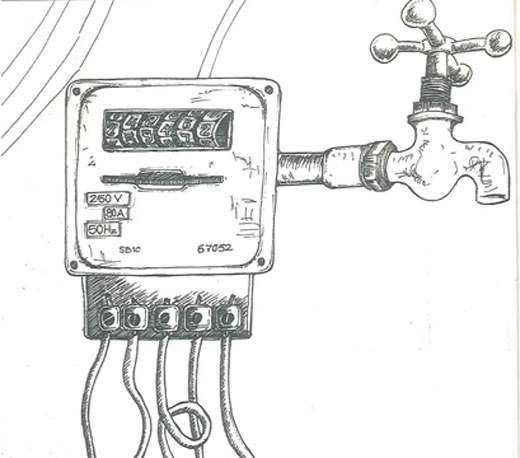 |
| Picture from The Water Cookbook by Bhagwati Prasad |
I love this description about the task of sociology of scientific knowledge (SSK) by Prof Sheila Jasanoff: “to render more visible the connections and the unseen patterns that modern societies have taken pains to conceal”. There’s the idea that it’s actually quite important for those in power to try and disguise certain stories and certain connections – to pretend that they don’t exist.
What is it for example, about the story of inevitable progress towards large-scale industrial agriculture, enhanced by biotechnology and supported by corporate investment, that makes it such an attractive solution for agricultural development in Africa, and who wins and who loses from this story?
Maize in Kenya
Here’s another example from the STEPS Centre. It’s about climate change and crops in Kenya, where there have been a lot of droughts in the last couple of decades. The big story there is that science and technology will fix the problem, that scientists will deliver new drought-tolerant seeds to poor farmers through a kind of pipeline, where farmers are the end customers.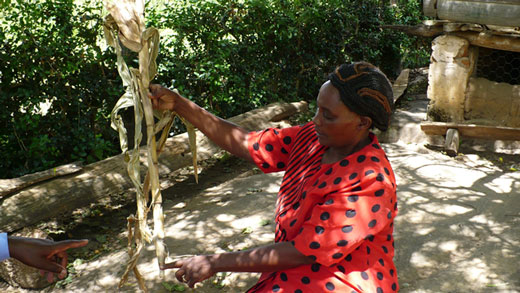 |
| Photo: Sally Brooks |
What our project did was go to some small farmers in a very dry region called Sakai, where they farm maize, and we listened to their stories and looked at how they actually make choices about which seeds or crops to use, how that fits with their daily life.
We used a technique called Multi Criteria Mapping to identify the farmers’ criteria for making their choices, like how important is the cost of seed, vs. how important is cooking, for your selection of crop. And we asked them to think about what they could do differently in response to all these droughts, and to rank the different futures that they imagined for themselves.
And then we compared this data from the small farmers, we compared it to what lots of other different groups thought the farmers should be doing – seed companies, scientists, policy makers etc. and what they thought the criteria were. And the stories were different, the little stories started to challenge the bigger story that everyone thought was obvious.
There’s a new section on the STEPS website all about methods which will explain how it works in more detail, and explains some other methods too.
The power of little stories
By comparing and exposing these stories we are saying: the big story is not the only game in town. There are always other pathways and other possibilities – however much some people would like to deny them, and it starts with listening to people and taking them seriously.Stories don’t operate in a vacuum. These big stories are swimming in a sea of institutions and social and environmental change, shaped by politics and power. So in this context telling a different story is a profoundly political act.
When we see these big stories we need to look at who is winning and losing, we need to broaden out the debate about the future to include more people, more kinds of knowledge. It’s not only more fun and more interesting, I think you get a better result.
Subscribe to:
Posts (Atom)