Showing posts with label Future Health Systems. Show all posts

Wednesday, 5 November 2014

Buzzfeed: A new home for research?

When the Policy Influence and Research Uptake team for FHS first outlined its strategy, it enumerated a number of key principles that underpinned our work. One of them was:
"'Being there': Where possible, instead of creating new communication channels and activities, the consortium will employ a 'being there' approach of accessing and using existing channels."

For us, that has meant engaging audiences on their home turf, not just bringing them to our work. In Bangladesh, for example, we've built out the FHS work into an existing programme of work at icddr,b with its own steering committee rather than building up a standalone programme.

On the web, this has also meant finding new ways of engaging users with our content. At the beginning of the consortium, that meant building up our social media presence on Twitter, Facebook, and GooglePlus -- just to name a few. It also meant adding our referenced work to relevant Wikipedia articles, for example maternal health in Uganda.

But, as the online world continues to change, so must we. One of the more popular websites these days is Buzzfeed. And in the interest of experimentation, we've been repurposing some of our content for that site.

Buzzfeed? What's Buzzfeed?
You might know Buzzfeed for its fondness of lists (i.e. 23 reasons you know you're from x), but it is much more than that. It may drive traffic to its site using lists and quizzes, but it also has a burgeoning news operation.

For those of you unfamiliar with Buzzfeed, here's a quick introduction from Kate Hawkins at the ReBUILD consortium:

BuzzFeed is an online news portal that creates and aggregates content (using the term news lightly as there are a lot of 'fun' stories on the site, kittens in dresses, that kind of thing). BuzzFeed authors have a fondness for lists, infographics and quizzes. It is the type of content that you regularly see shared on Facebook and other social media sites. It is very popular with younger people. In terms of audience an estimated 24 percent range between the ages 18-24; 28.7 percent are between 25 and 34 (figures from May 2013).

How have we experimented?
For FHS, our foray into Buzzfeed started with a parliamentary inquiry into the the UK Department for International Development's (DFID's) approach to health system strengthening.
As a consortium, we had not only submitted evidence to the enquiry, but also had our CEO participating in the Guardian Development Professional's discussion on health systems strengthening. It's not a topic that is usually at the front-and-centre of mainstream development debates, so we wanted a quick and easy way to bring people up to speed on what health systems are, what approaches to health systems strengthening are out there, and what DFID's approach has been. That's when we thought the Buzzfeed 'splainer (short for 'explainer') format might be a good approach.
So, in time for the Guardian discussion, we produced a Buzzfeed community post: 7 Things Everyone Should Know About DFID's Approach To Health Systems Strengthening.

Has it been successful?
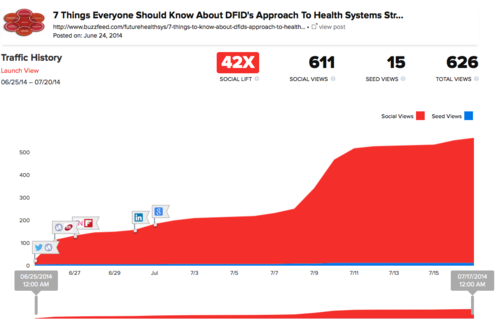
Much to our surprise, that post garnered a lot of attention. 'A lot' is a relative term, of course, but our '7 things' Buzzfeed attracted about ten times as many views in the first week of its posting as a blog we put on the FHS website (albeit on a completely different topic) the week before.

If you've not done a Buzzfeed before, you might not know that it has a really easy-to-use, in-built statistics dashboard for each post. Here's the headline 'launch view' (i.e. the first week) of traffic to our first Buzzfeed post.

Launch view of our first Buzzfeed post
And, while not everybody was a fan:
The overwhelming response was very positive! Neil Squires, the former head of profession for health at DFID said: 'I enjoyed the contribution - a great short summary of health systems.' We also got a number of emails from various professionals around the world saying how much they enjoyed it.
So, following from that rather unexpected success, we've produced a couple more Buzzfeed posts, that have both been well received.

The first, 10 Pictures That Explain The Challenges Of Motherhood In Uganda, was based off a research project in Uganda that used the photovoice methodology. We've also produced a more traditional downloadable PDF (and printed some copies for distribution at HSR2014). The result? Again, more than 10 times more views on Buzzfeed than downloads of the PDF.

That post also got the most engagement we've ever had on our Facebook page -- with over 8,000 reached and around 60 'engagements' (likes, comments and shares).

We've also branched out into collaborative Buzzfeed posts with Everything You've Ever Needed To Know About Health Systems. If you'd like to contribute to it, just let us know!
Hopefully this isn't the last Buzzfeed you'll be seeing from us.

By Jeff Knezovich, FHS Policy Influence and Research Uptake Manager, Institute of Development Studies

Everything You’ve Ever Needed To Know About Health Systems

New to the wonderful world of health systems? Then this post is for you! Whether you're a wonk that needs to brush up, a student, a health care practitioner or just an interested and engaged citizen – this primer is full of everything you've ever needed to know about health systems and how they function around the world.

View original post on Buzzfeed >

Friday, 24 October 2014

Training health workers in management skills bears fruit

The Challenge
Every day, health service leaders face challenges like working with limited resources while delivering results, managing change, and keeping staff motivated. Decentralisation adds to these challenges, as many health workers have both clinical and managerial responsibilities.

However, little attention is paid to leadership and management skills during their health training.
Communities, donors, local politicians and opinion leaders are demanding accountability and results, which is achievable with simple leadership and management skills.


Our Intervention
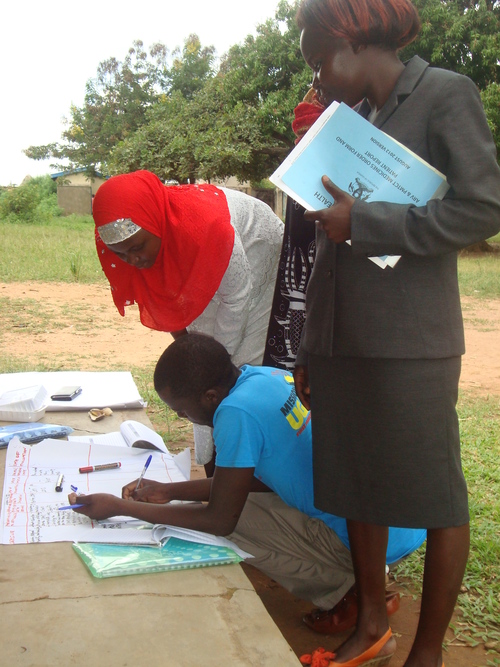
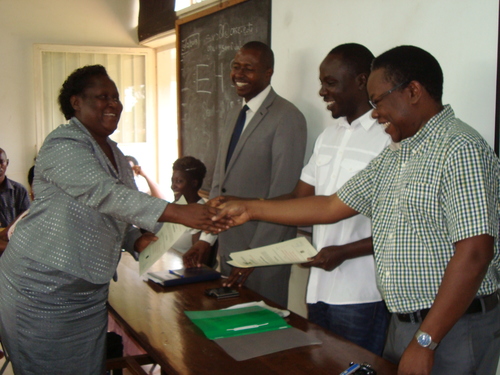
In partnership with the districts, who select the candidates, the Makerere University School of Public Health is training health workers in three areas: planning and management of health services, improving management of logistics and improving management of labor and newborn care.

A six-month distance health services management certificate course, targeting district and health facility managers, caters for the first two thematic areas, the focus for this article. In the first phase, 30 health service delivery personnel were drawn from the three study districts (10 from each), and another 30 are attending the second phase of training. The results have been tremendous, with beneficiaries already registering significant improvements back at their work places.


Initial Success
Stephen Otukor, a clinical officer in Pallisa district, said that the financial management skills he acquired during the training are invaluable.

Before the training, spending and finances were not streamlined. Now all his staff know how his clinic's financial resources are used.
"The other good thing is that when we collect the data nowadays, we analyse it, and we utilize it," adds Stephen. "This has helped us in decision making. For instance, if we plot a graph and find problems, we trace the root causes of why. We then find solutions to the challenges."
For Edith Bogere, a senior nursing officer with Kamuli district, turning support supervision into a blame game and police-like interrogation had failed to solve a long-standing problem. But, while still on the course, Edith decided to employ her new skills by suggesting the involvement of the in-charge of the health centre and the staff to find solutions.
"The in-charge gave us her views, and one of them was to change a midwife that was there to another health facility and get her another one or two. And the district health management team respected her opinion. We have since seen deliveries increasing in this facility, even the OPD attendance is improving. When you compare the HMIS report 105 of Bupadhengo now and those before, you see a marked improvement. This is simply because we were able to change our approach to supervision and problem solving."
And in the case of Anek Santurinah, a midwife in Pallisa, time management was a problem. "Things like phone calls and visitors who came unnecessarily would take my time. I would sometimes attend to these visitors and ignore clients. But this changed after the training."

By the end of the study, each of the three districts will have had 30 key personnel trained in health services management.

By Kakaire Ayub Kirunda, FHS Uganda Policy Influence and Research Uptake Officer
[Editor's note: This article is the first in a series of updates from the FHS Uganda team that were also compiled in their recent Showcase.]

Wednesday, 22 October 2014

Minimising delays for maternal health seeking in Uganda through saving schemes

The Challenge
When Mrs X (real name withheld) went to her local health centre in one of our intervention districts for a final check-up just one month before her expected due date, she never anticipated what the midwife told her. She was told to make plans to deliver at the health centre or a general hospital because there was a likelihood of her delivery being complicated.

Mrs X had an unusually large baby and needed to deliver in a health facility where caesarean section could easily be offered in time if the need arose. Sadly Mrs X had not saved for the anticipated expenses in form of transport fares, upkeep and the surgery. By the time Mrs X went into labour, her family could hardly raise the transport fare and by the time her husband got the money, a traditional birth attendant had been called in and was failing to help. Mrs X and the baby were lost a few metres from the hospital!

Without any kind of savings in the house to cater for transport Mrs X's family delayed reaching care. The family of Mrs X is not in isolation. There are many more like it.

Our Intervention
Households and individual community members are being educated and encouraged to join or start financial social networks, like saving groups, which offer financial protection. In addition to the business funds, the networks are advised to have a separate fund to cater for maternal and newborn health needs. Members can access these funds to cater for emergency transport to and from the health facility for pregnant women, mothers and newborns. The fund is also meant to provide funds to cater for birth items. Saving groups are similarly encouraged to enter into partnership with transporters.
At inception of the study in 2013, 816 existing groups of all manner and 795 transporters (boda boda drivers) were oriented on the new initiative.

Initial Success
Twambagane Saving Group is one of the groups that has been established in Kamuli district as a result of the orientation and training. With 34 members — 26 women and 8 men — the leader Godfrey Kisubi, who is also a CHW, says membership is closed. His strategy is to encourage groups with manageable numbers that only open up to more members after gaining experience.

Group member Miriam Kisakye is very proud and happy to be part of the initiative. "When the labour started we did not have readily available funds for transport to hospital but our savings in the group came in handy. Let those who have not started such groups act immediately because they are very beneficial," says Miriam who had given birth just two weeks prior to our visit.

There is good news in Pallisa as well, as Betty Opolot, the leader of Puti Puti Central Saving Group explains:
"I attended training organized by MANIFEST. After the training, we organized the women and talked to them about the issues related to maternal and newborns and the reasons why we need to save money specifically for maternal and newborn emergencies. 21 women managed to join the group. The saving group started this year (2014) and so far we have saved 500,000 Uganda shillings [. So far one woman has accessed the funds to cater for her transport needs to the hospital."
If this momentum is not lost, it is believed that the cases of Mrs. X will be greatly reduced. As at end of August 2014, a total of 1260 groups had an MCH (maternal and child health) fund.

By Kakaire Ayub Kirunda, FHS Uganda Policy Influence and Research Uptake Officer

[Editor's note: This article is the first in a series of updates from the FHS Uganda team that were also compiled in their recent Showcase.]

Tuesday, 21 October 2014

Community health workers encourage women in Uganda to seek skilled care early in pregnancy

The challenge
Deciding to seek care from a skilled health worker by a woman at the time of delivery is highly encouraged in order to improve health outcomes for both mother and baby. When a woman delivers under skilled care, it is easier to detect and attend to any emergences that arise. However in Uganda, 42 per cent of the estimated 1.2 million women who conceive every year do not deliver under skilled care. Some of the drivers of this sad state of affairs include: poor understanding of complications and risk factors in pregnancy and of when emergency medical interventions are necessary; previous unfortunate experiences of health care services; and acceptance of maternal death as something normal in many communities.

Our Intervention
Still under the community mobilisation and sensitisation component of the study, around 1,691 community health workers (CHWs, also known as village health teams or VHTs), were trained across the three study districts of Kamuli, Pallisa and Kibuku. The training focused on early detection of emergencies, birth preparedness and care for mothers who just delivered and their newborns. During the visits, CHWs provide households with information needed to ensure mothers have a safe delivery and remain healthy with their babies. Two home visits happen during pregnancy and two after delivery.

Initial Success
Ms Grace Asio is a mother of five with her youngest child delivered in early 2014. A mother of five, Grace has conceived seven times since getting married, but lost two pregnancies. She attributes that loss to a failure to appreciate the danger signs and to seek medical care in time.

"On both occasions I bled to near death and would get to hospital late. But all this happened because I did not know that bleeding was a danger sign. But now I can at least tell what the danger signs are during pregnancy. Upon detecting any I quickly tell my husband and we find ways of going to the health centre as fast as possible."

Mr Francis Kedi is the CHW for Okisiran central village in Akisim sub-county of Pallisa district, where Grace resides. Grace has nothing but praise for him. According to Francis, it was not easy "to get into some homes initially because the men thought we were going in to use their families as bait for some personal economic gains."

He adds: "We persisted and explained that what we were doing was for their good and many came on board save for a few perennial drunkards."

Beaming with pride, Francis further intimates that he is increasingly seeing the women he has visited seeking care in time whenever they suspect a problem with the pregnancy, and opting to deliver from health facilities. Francis has visited 65 homes with pregnant women in the last year.
And the outcomes are not any different from Grace's.

A total of 35,108 home visits had been made by the end of August 2014 across the three districts.The home visits by the CHWs who are always armed with flipbooks and demonstration mama kits are enabling women and families prepare better for birth and make informed timely decisions.

By Kakaire Ayub Kirunda, FHS Uganda Policy Influence and Research Uptake Officer

[Editor's note: This article is the first in a series of updates from the FHS Uganda team that were also compiled in their recent Showcase.]

Tackling negative social cultural norms in Uganda through community dialogues and radio

The Challenge
Having knowledge of obstetric danger signs and embracing good birth preparedness practices could enhance maternal and newborn health outcomes. For example, a woman, working with her family, can choose her preferred birth location; choose her preferred birth attendant and make advance arrangements with that provider; make advance arrangements for transport to the skilled care site; obtain basic safe birth supplies; and save or arrange alternative funds for costs of skilled and emergency care.

However, in many Ugandan households, especially in rural areas, it is taboo to make these preparations. As a result, by the time of delivery, many are stuck in a reactive mode, which has sometimes led to death of either the mother or newborn, and sometimes both.

DSC00310.JPG


Our Intervention
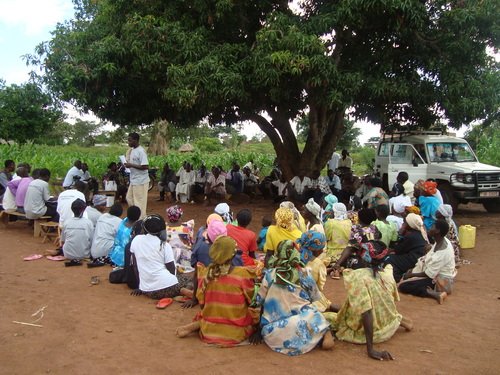
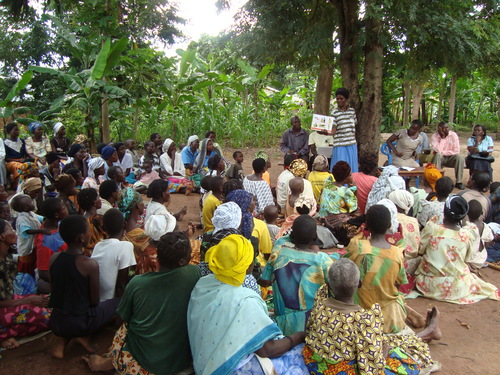
Through the use of communications and media advocacy, the intervention study is tackling social and cultural issues that affect maternal and newborn health negatively. We are using village-level dialogues (once every three months) and radio talk shows (monthly) as well as spot messages (daily). The dialogues and talk shows offer a platform for discussing these issues and rally community suggestions and participation in addressing them. This community involvement promotes ownership and sustainability of behavioral changes. The dialogues are also expected to provide peer influence in favour of healthy maternal and newborn practices. And as convenors of the dialogues, village health teams (VHTs) have shared vital knowledge that is slowly changing the negative attitudes towards birth preparedness.

DSC00350.JPG

Initial Success
During the dialogues, women and men shared sad memories of maternal and newborn illness and death, underlining the grim reality of the situation. They also discussed good and bad practices and made commitments to abandon negative practices and therefore improve maternal and newborn health.

"I resolve to stop putting cow dung and other dangerous things on the cord of newborns. After today's talk I realise why my baby's cord took that long to heal. I urge fellow women to join a new me," said Ms Nabirye at a dialogue in Kamuli to thunderous applause from fellow women.

Monitoring data shows that, while only 17 per cent of sampled women who had just given birth treated cords with nothing but the appropriate saline water in mid-2013, that percentage had shot to 56% in mid-2014.

Mr Francis Kedi, a CHW in Pallisa says he has observed that more families are now appreciating delivery under skilled care, a view backed by monitoring data. In mid-2013, deliveries in health facilities in the three districts stood at 66%. As of May 2014, that
number had jumped to 84 per cent.

As at the end of August 2014, a total of 73,429 persons had attended the meetings. And if one of the goals of dialogue is to find common ground and find better solutions, then this is starting to manifest itself in the context of maternal and newborn health in the districts of Kamuli, Pallisa and Kibuku.

By Kakaire Ayub Kirunda, FHS Uganda Policy Influence and Research Uptake Officer

[Editor's note: This article is the first in a series of updates from the FHS Uganda team that were also compiled in their recent Showcase.]

Wednesday, 15 October 2014

Research methods for people-centred health systems: Photovoice

In our previous blog post introducing how FHS approached the Third Global Symposium on Health Systems Research, we highlighted the thematic focus of the symposium is 'people-centred health systems'.

FHS has been working for some years to put people first when it comes to health systems, whether it be through understanding how people actually use new technologies, such as in our project on health information seeking behaviour in Bangladesh, or working with communities in Afghanistan to rate and improve their health services through community scorecards.

But putting people at the centre of health systems also means finding different research approaches to studying health systems strengthening. We're profiling a few methods during the symposium. And today's focus is on photovoice.

A bit about photovoice
Photovoice is a visual research methodology through which people can represent, and enhance their community by photographing their daily lives and the lives of those around them. It is a qualitative and participatory research method that aims to capture what occurs when researchers are not necessarily present.

Following a range of trainings – on how to use digital cameras, how to approach a picture subject, and getting people's consent – study participants use the cameras provided to them to capture photographs and moments that are relevant to the research study. These photos are then discussed, often in a group, to highlight particular photos and to explain their particular relevance to the topic at hand. In many cases, these photographs then also serve as a key part of the communication strategy of the research project.

How FHS has employed photovoice
Although this is a relatively new approach for us, The Future Health Systems consortium has already used the photovoice technique in two of our focus countries: Uganda and India.

In Uganda, as part of the FHS young researcher grant, David Musoke worked with select youth in a community in rural Uganda to document issues related to maternal and childhood health in the community. Study participants used the cameras provided to them to capture aspects and situations in their community where youth can contribute to improving maternal health for a period of five months. Monthly meetings were held between the youth and research team to discuss the photos and to identify collectively emerging themes and areas for action. See the Uganda photovoice slideshow below, or download the booklet, to see some of the results.


Health facilities in rural areas do exist
FHS Uganda Photovoice: EriaMdidde
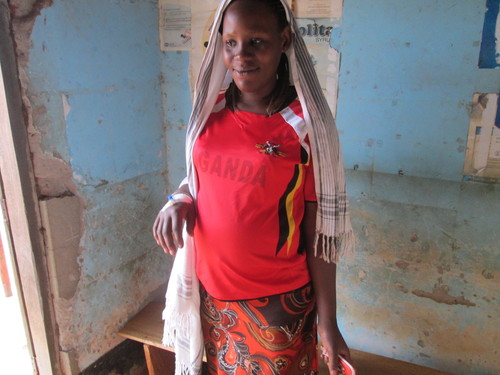
OK, maybe it sounds obvious. But the problem isn't necessarily that there are no health care facilities for women. While a considerable number of women in Uganda do choose to give birth in their homes, it isn't necessarily because of a lack of facilities.

Despite stories of limited numbers of qualified health workers and the poor attitudes these workers can take towards pregnant women, they manage to serve many women and children.

Pictured here is a pregnant woman who is smiling after having received adequate care at a local health facility.

But that doesn't mean they're easy to get to!
FHS Uganda Photovoice: Denis Mpiima Mukooza
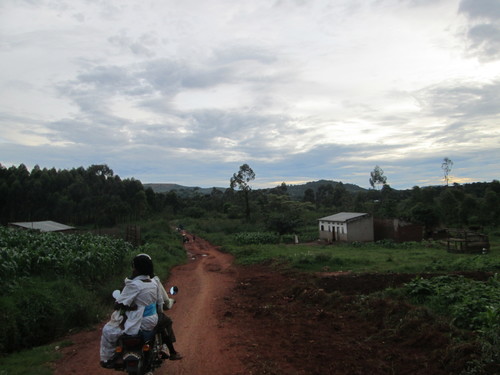
To reach health facilities and trained health workers, women from this particular village in Central Uganda must travel over 7 kilometres (5 miles). It takes both time and money to travel there, which limits the number of antenatal and post-natal visits expectant and new mothers make.

A common way to get to the health facilities is on a hired motorcycle, known as a bodaboda. These motorcycles are convenient, and they're one of the few means of transportation that can navigate the rugged terrain, but they're not a particularly safe way to transport pregnant women. But there is little choice.

In this picture a mother takes her young child to a health centre for an immunisation.

Getting there is half the challenge, getting seen might be just as difficult
FHS Uganda Photovoice: John Ssewadda
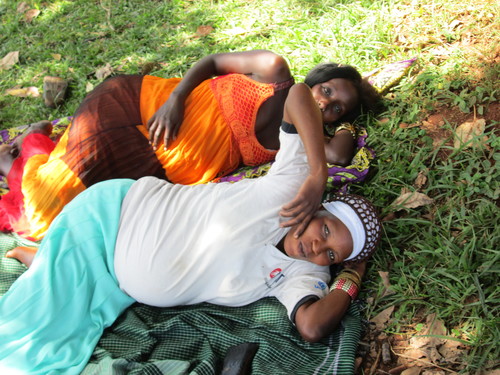
After walking or taking a bodaboda to get to a facility, many would think that the hard part is over. But getting to a facility is just the first problem an expecting mother might face: often pregnant women must wait several hours for a consultation.

Here, two pregnant women lay on the grass outside the health centre waiting for the health workers to arrive.

'Free' doesn't really mean 'free'
FHS Uganda Photovoice: Annet Nakayima
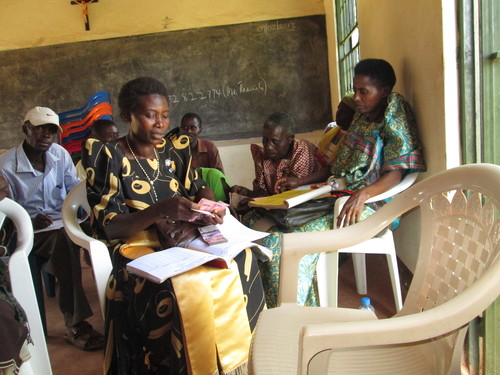
There are costs associated with getting to a health facility, but the Ugandan government says that health services provided at government facilities should be free. Apparently the Ugandan government doesn't define 'free' the way the rest of the world does.

Because of limited funding from the government and from international sources, many facilities are forced to charge for basic materials like latex gloves. In cases where women were expecting that they wouldn't need to pay, or who are simply too poor to pay, this can result in death.

In this picture, a woman counts money collected in a local savings group which can assist members when in need particularly pregnant women during time of delivery.

Many don't know about the risks of early pregnancy
FHS Uganda Photovoice: Anthony Mpanga
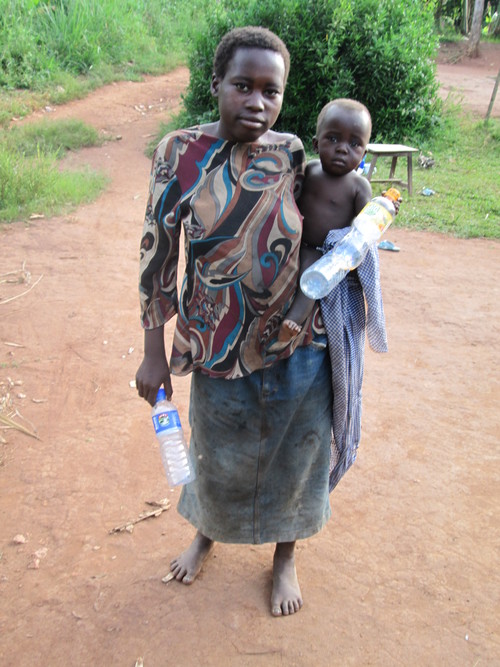
Teenage pregnancy is associated with greater complications for both the mother and child, which can often result in death. But in Uganda, the median age for a mother at first birth is 18.6 years.

Pictured here is a pregnant teenager who is also carrying her first child in her arms.
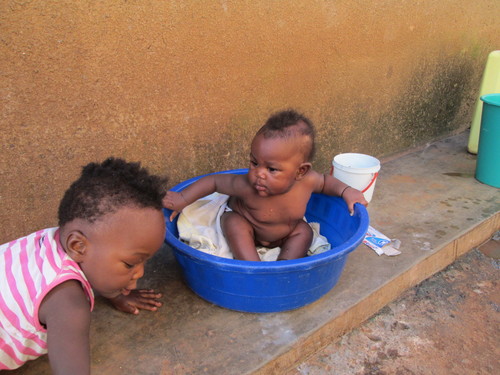

And there is still limited use of contraception
FHS Uganda Photovoice: Roger Mubiru
Although several methods for contraception are available in Uganda, many couples do nothing to space their children. This is partly due to lack of awareness and availability of contraceptive services at many health facilities particularly in rural areas. The country's unmet need for family planning among married women is currently 34%.

In this picture are two siblings who can be mistaken to be twins, which is an indication of lack of use of family planning methods. As the older is only learning how to crawl, the young one is starting to sit.
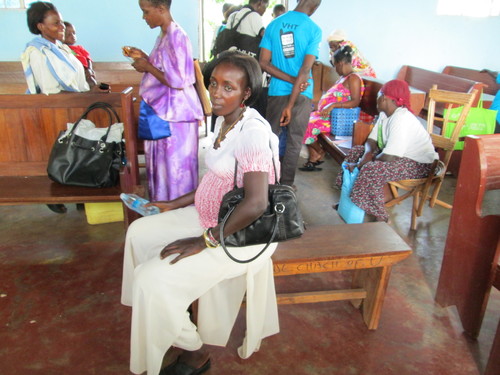

There remains low male involvement
FHS Uganda Photovoice: Annet Nakayima
The Ministry of health has made efforts of increasing male involvement in maternal and child health issues. Indeed, pregnant women who are accompanied by their spouses to public health facilities for antenatal care are attended to first before those who are alone. However, male involvement is still very low.

Here, a pregnant woman not accompanied by their spouse for antenatal care waits to be seen by a health worker at a government health centre.
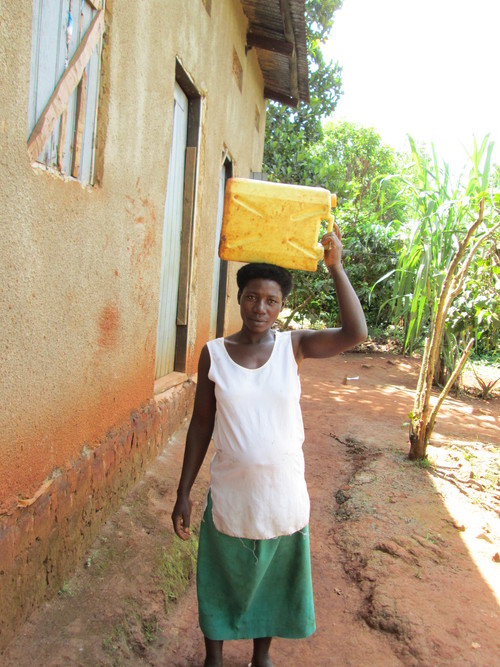

Being pregnant doesn't mean there's relief from household chores
Being pregnant doesn't mean there's relief
from household chores

FHS Uganda Photovoice: Roger Mubiru
Women in rural Uganda do a lot of domestic work. This includes cultivation, washing clothes, cooking, fetching water and other household chores. One would imagine that when these women are in their final weeks of pregnancy and soon after delivery, they are relieved of some of these strenuous duties. However, this is not the case in most households.

In this picture is a pregnant woman a few weeks from delivery as she was from collecting water from a distant water source for household use.


In India, researchers worked with women's groups in the Indian Sundarbans of West Bengal to document the interplay between climate, health and resilience there. The focus remained mainly on maternal and newborn health. The participants mainly sought to capture images that explain how a changing climate affects their daily livelihoods, barriers that exist to accessing health services, and ways that locals are adapting to these challenges. The results are available for download in our FHS India photovoice booklet and for viewing in the slideshow below.
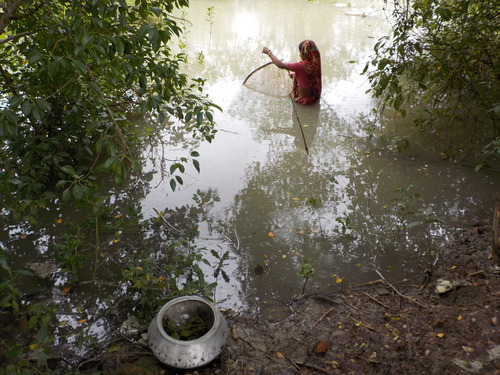
Meen dhara: A costly way to make a living?
Photographer: Bandana Haldar, (Binodhpur, Kultali)
Meen dhara, or prawn seed collection, is a traditional way of making a living in the community. But dirty water is becoming more of a problem, especially for women collectors. The dirty water can get inside women, causing uterine infections.
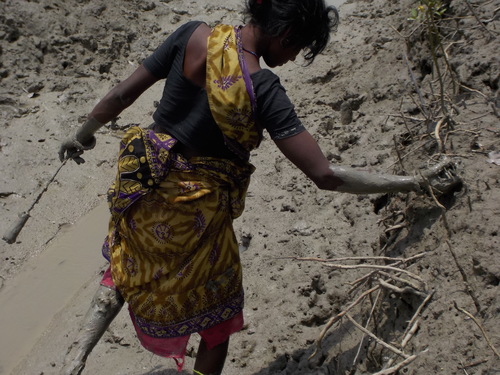

Crab catching
Crab catching
Photographer: Parul Bhakta (Satyadaspur, G-Plot)
Crab catching is one of the few livelihoods remaining in one community, but it's very strenuous, risky and time-consuming.

'Sometimes you get wounded, causing heavy bleeding... then you have sit quietly, waiting for your body to absorb the shock... then you can start working again.'
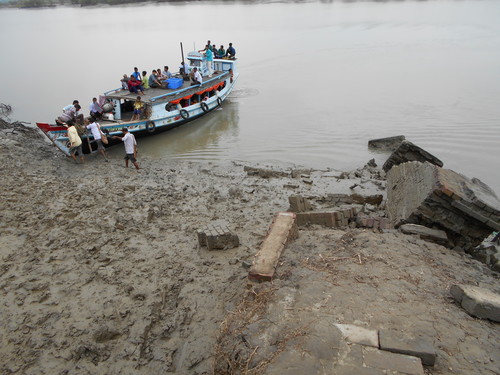

A broken ferry ghat
A broken ferry ghat
Photographer: Sita Das (Jayasree Colony, G-plot)
This ferry landing (ghat) has been broken for last three months. This is the only way to cross the river. The mainland, where the nearest Public Health Centre is located, is on the other side.
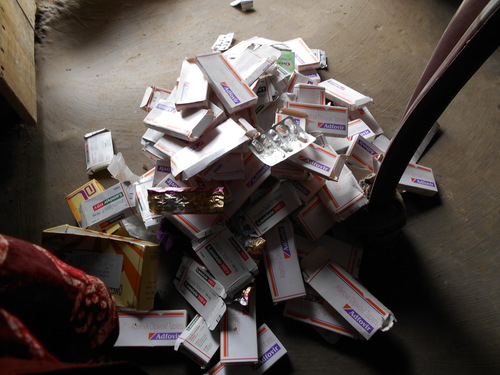


The cost of medicine adds up quickly for those with chronic conditions
Photographer: Lakkhana Debnath (Jayasree Colony, G-Plot)
'I am suffering from a chronic disease... Medicines are very costly and not always available here. I have shifted to a rural medical practitioner (RMP) who gave me medicines on credit.'
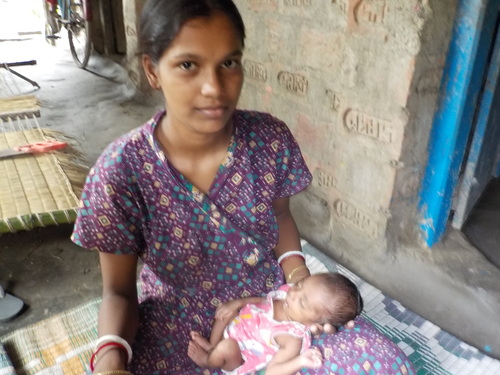

Teenage mother coddles a baby born at a low birth weight
Photographer: Sipra Haldar (Binodhpur, Kultali)
'The girls in our community often get married at the age of 13 or 14. The girl in the picture gave birth to a low-weight baby at the age of 16. Parents often marry off their daughters at an early age to reduce the number of family members. It's a way of managing resource constraints.'
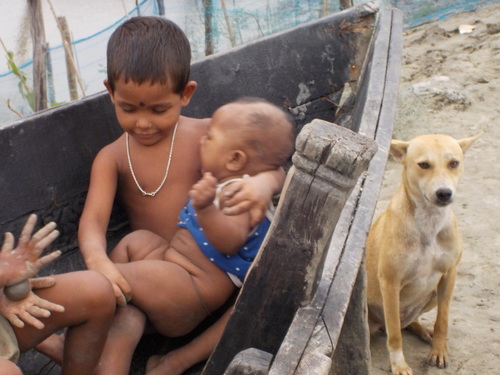

Older children as caretakers
Photographer: Bornali Giri (Nogenabad, Kultali)
'I leave my younger child with the older one. I know it is very risky but we have to sustain.'
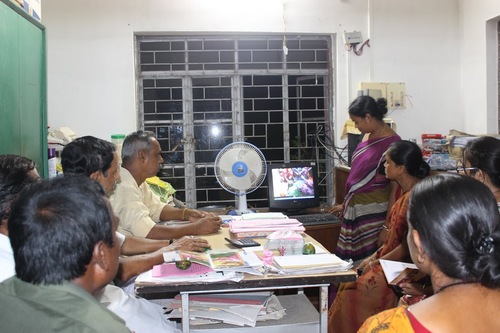

Discussing findings with decision makers
FHS India photovoice participants meet with the local self-government (panchayat) to discuss health issues highlighted through the photovoice process.

Giving photovoice a try at HSR2014


On Thursday, 2 October 2014, FHS invited participants at the Symposium to take pictures with Instagram and Twitter and to tag them with #HSG2014PV, #HSR2014PV or #HSR2014. These were collected via Evenstagram to form our own snapshot of the Symposium for the day.

You can review the photos below or online. Let us know which ones are your favourite and why!

By Jeff Knezovich, FHS Policy Influence and Research Uptake Manager.

Thursday, 2 October 2014

A Fork in the Road in Implementation Research: Swerving towards people centeredness

Mistakes are guaranteed. Learning from mistakes is not guaranteed. Implementation research is an attempt to maximize the chance to learn from our own and others' mistakes. Several forces array against successful learning from mistakes:
  1. Mistakes create benefits to small groups who will fight attempts to detect or correct them.
  2. Mistakes embarrass the leaders because infallibility is mistakenly presumed to be a leader's birthright.
  3. Mistake detection is an extra expense, and dollars spent to monitor don't obviously save lives the way direct services do.
Health systems researchers face a fork in the road. One path leads to implementation research as big science which can anoint a priestly caste of implementation experts pursuing universal truths and codifying best practices in mistake correction. The experts' business model is to sell expertise to clients and research foundations.

Another path leads to implementation research as small science — a cottage industry practiced by every district health officer, clinic manager, and MoH official. As small science, implementation research would become a widely prevalent skill in systematic and organized mistake detection. Everybody has to muddle through. Some keep repeating the same mistakes. There is a better way to muddle through, and we need health system functionaries at all levels to be experts at mistake detection and correction. The forces that perpetuate mistakes need to be engaged on local battlefronts one small sub-district, province, or ministry at a time.

The crucial choice for implementation research is whether it is to be identified as an epic search for universal solutions or as a platform to spread established methods of finding local solutions. The proliferation of self-identified global health experts and an organization calling itself "Health Systems Global" speaks to the seduction of searching for universal solutions. The latest seduction has been systems science. Many, myself included, have approached the construction of health systems models and simulations as a search for distilling eternal truths about health systems. After the "Eureka moment" the systems scientist announces a new universal principle and thereby changes the world. Right? Wrong!

What follows is the predictable disjunction between the researchers' distilled knowledge and implementation. Shortcomings in the small, local manifestation of policy research are a prevalent block to big science implementation research. For a discipline committed to mistake detection it would be unseemly for implementation research to perpetuate the myth that global decontextualized knowledge is readily recontextualized. This is not a false dichotomy, it is a real one. The more we push a paradigm that implementation research is the province of rigorous scholarship, the more we disable practitioners from accessing readily available approaches to doing their jobs better.

There is a different version of implementation research called participatory modeling, and even if some doubt how participatory the approach truly is, it is at least designed to engage the implementers themselves from the very beginning of the problem solving journey. A partnership forms where stakeholders and systems scientists convene to use the symbolic tools to identify and diagram the way a small system of interest to a planner can support the implementation of new policies.

A shared understanding of how organizations work can focus attention on where mistakes should be anticipated and how system reforms may lead to other mistakes. Here, implementation research is more a practice of mindful implementation. Indeed it is a style of managing one's implementation using practical research than it is a quest for universal principles.

To embark on the pathway to spread implementation research as a practical learning technique to be practiced broadly will rain on the ambitions of many would-be heroes of global health knowledge. Don't fear, they won't go away. Proof that big ambitious policy research is inert doesn't seem to slow it down. Luckily the evidence that building universal capacity in small and local systems thinking helps change policy for the better does appear to be leading to enthusiasm and growth.

Miraculously, there is a groundswell of interest in taking the small narrow road to powerful ignominy rather than the broad glorious road to powerless notoriety. More and more health systems researchers are focusing on moving skills in mistake detection and mistake correction closer to the people affected by mistakes. This approach epitomizes people centeredness. It can involve people in an ongoing cycle of vigilance to make their local health policies autonomously mistake-correcting.

Academicians who feel threatened by turning over control and authority to the people affected will object that deep complexity of health systems requires brainiacs and super computers. These guys don't get it. The utopian health system guided by global best practices is a pipe dream.

What is in our reach are real health systems everywhere in which more people are more involved in mistake detection and correction. The spread of the practice of small, local implementation research can spread the word on the necessity of people's involvement and watchful scrutiny every time one implements. This is a radical idea, powered by truth. It is exciting to see health systems researchers shed laurels and roll up sleeves to share the word that everyone makes mistakes and everyone should work on fixing them. This is the future of implementation research.

By David Bishai, Professor, Johns Hopkins Bloomberg School of Public Health  

Research methods for people-centred health systems: Social network analysis

As the first two plenary sessions have already highlighted, the focus of the Third Global Symposium on Health Systems Research here in Cape Town, South Africa, is on people-centred health systems. For FHS, which has unlocking community capabilities as a core theme, this is a welcome focus.

But if we're focusing on people-centred health systems, what are the implications for research? We've been exploring a number of methodologies during our research that we will be highlighting throughout the symposium.

For today, the focus is on social network analysis, or SNA.

A bit about social network analysis
SNA allows for identifying and measuring relationships and connections among people, organisations, or other units. By modelling communication, funding, and other pathways among, within, and between people and groups of people, researchers can understand the diffusion of knowledge and innovation, as well as the formation of new relationships over time. In a complex system, social network analysis can also support system conceptualisation.

A social network analysis comprises of a number of nodes, or people, connected by a relationship. This link is known as an edge. SNAs are often visualised in a network map, and network scientists have devised a number of mathematical functions to help describe networks. Often, there is a focus on the density of a network (how many connections individual nodes have), and finding how central a certain node is within a network.

How were using SNA in our research
As part of the FHS India team's in-depth look into the state of maternal and child health services in the Indian Sundarbans of West Bengal, they have done an SNA study examining the social networks of mothers in two remote villages.

In these villages, a number of the men out-migrate to the nearest big city, usually Kolkata, for work. The SNA purposively selected a group of mothers with migrant husbands and another group of mothers whose husbands remained in the community to compare the networks. The SNA has evaluated support networks for cognitive, financial and material support to the mothers. The research brief is forthcoming.

Getting hands on with SNA
At the Third Global Symposium on Health Systems Research, in collaboration with Jess Shearer, we will be undertaking a participatory social network analysis (she will be presenting a detailed analysis at her session on Friday, 3 October between 11:30-13:00 in room 1.61-62). All members of Health Systems Global are invited to take the survey -- either at Stand 56 or online. We're looking at the social, collaborative and information networks of HSG members.

We've been using Google FusionTables to make the network map. Here's a snapshot of the HSG social network.

By Jeff Knezovich, FHS Policy Influence and Research Uptake Manager, Institute of Development Studies

Tuesday, 9 September 2014

Complex Adaptive Systems & health: new resources

complex1In June 2014, Future Health Systems (FHS) and the STEPS Centre co-hosted a workshop exploring Complex Adaptive Systems (CAS) approaches to health systems strengthening in low- and middle-income countries (LMICs).

FHS and STEPS are particularly concerned with policies, programs, and individual level interventions promote and protect people's health and wellbeing, particularly vulnerable and disadvantaged populations.

The workshop was designed mainly to build capacity among both consortia on specific methods for working with and understanding CAS.

Read the workshop summary
The Future Health Systems team has produced a summary from the workshop with
  • A brief run-down of methods relevant to Complex Adaptive Systems
  • Video introductions from Taghreed Adam and Ben Ramalingam (YouTube playlist)
  • Full video of 7 presentations from the workshop (YouTube playlist)
  • 7 blogposts on complexity approaches & their use in health systems research
View the summary on the Future Health Systems website.

Blog posts
Two articles by STEPS members in this series have also been re-posted on the STEPS blog:

Further reading
The Future Health Systems website has a theme on Complex Adaptive Systems, drawing together all FHS work in this area.

For more projects and publications in this area, see our Health & Disease Domain page.

The book Transforming Health Markets in Asia and Africa: Improving quality and access for the poor documents the innovative approaches designed to address the problems associated with unregulated health markets, and proposes a framework for understanding health market systems and outcomes.

Monday, 8 September 2014

The conversion of a complex adaptive systems modeling sceptic

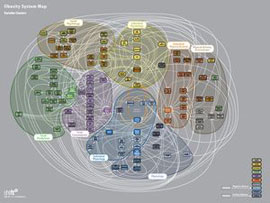
During the past few years complex adaptive systems theory has suddenly become very popular in the health systems research field. Somehow those crazy obesity (click through for a nice interactive version or see image above) and tobacco control causal loop diagrams resonated with researchers in the field. Before we knew what was going on the Alliance for Health Policy and Systems Research was publishing reports on systems thinking and the National Institutes of Health were holding conferences on complex systems and health disparities.

At some level, complex adaptive systems (CAS) are easy to understand and appreciate. As Josh Epstein likes to say we all constitute models in our head: "Anyone who ventures a projection, or imagines how a social dynamic--an epidemic, war, or migration--would unfold is running some model."

Yet it's tougher to see how CAS modeling can really contribute to health systems analysis in low- and middle-income countries, where data are frequently poor and incomplete. What's more, my first impressions of agent based models, which run on simple rules governing actions and interactions of autonomous agents, was that they seem to offer somewhat trite insights.

I have to admit that -- while the notions of tipping points, and emergent behavior and path dependence all made absolute sense to me, and seem like valuable lines of enquiry for more qualitative research -- until recently I was something of a complex systems modeling sceptic. I thought it was fine for those people who work on disease transmission and outbreaks, but not cut out for exploring health worker policy issues, or health financing.

However, a couple of recent events, notably the FHS workshop and the NIH conference mentioned above, have changed my perspective. What has driven my change in thinking?
  1. Modeling CAS can be a little scary if not explained well! Previously differences between agent based modeling and systems dynamics models, and how one would go about setting each of these up, were simply not clear to me. As a consequence, they remained remote and impenetrable.
  2. CAS modeling is not a solo endeavor, and I don't really need to be a modeler to participate. It seems that CAS modeling is best done in multi-disciplinary teams who collectively explore the nature of relationships between the different variables, bringing different perspectives to bear. This kind of collaborative process can include researchers, practitioners and/or policy makers who are best placed to understand what kind of interventions may be feasible, and sometimes community members, as well as the modelers. Indeed participatory modeling seems to be quite a major force within the CAS field.
  3. The need to apply complex adaptive systems models to health systems is increasingly evident. This is a critical point for me, and one that has emerged from our ongoing work. For example, as our FHS colleagues in China struggle to work out how to analyze a health system that seems to be in an almost constant state of change, traditional impact evaluations look increasingly irrelevant. Instead, we need methods that can capture the ripples of health reform throughout a system, identify unforeseen consequences and force us to think more clearly about how context affects an intervention. CAS may help on all of these fronts.
So for those of you who know me well, don't worry, I am not about to become a Vensim or Netlogo whiz… that is too far-fetched! But if you're thinking of a collaborative modeling project on health systems addressing the effects of financial incentives for health workers, or reactions to regulatory reforms for example, then count me in!

By Dr Sara Bennett, FHS CEO, Johns Hopkins Bloomberg School of Public Health

Communicating complexity

Editor's note: This blog is part of a series of reflections emerging from a workshop on complex adaptive systems research methods held in Baltimore in June 2014.

Many will recognise the causal loop diagram above, outlining counter insurgency dynamics in Afghanistan. The New York Times reported that when then General Stanley McChrystal, who was leading the American effort in Afghanistan at the time, saw this diagram presented he quipped: 'When we understand that slide, we'll have won the war [in Afghanistan]'.

And while the room was reported to have erupted in laughter around him, it begs a more serious question: is it possible to communicate complexity without being ridiculed?

Can we even communicate complexity?
While some have risen in defence of the diagram and of its creators, PA Consulting Group, others have been less kind. Alexander Galloway (2011) in his article 'Are some things unrepresentable?' cites it as an example of a critical tension in communication where the more information that is represented the less information is actually conveyed:

"Despite an overwhelming amount of detail, the PowerPoint slide is not easy to digest. In fact, the high level of detail seems to hinder comprehension rather than aid it. Unlike realism in painting or photography, wherein an increase in technical detail tends to bring a heightened sense of reality (at least in the traditional definition of aesthetic realism that has held sway more or less since the Renaissance), the high level of technical detail visible here overwhelms the human sensorium, attenuating our sense of reality. Rather, like a fractal whose complexity does not decrease when viewed through a magnifying glass, the information contained in McChrystal's PowerPoint does not grow more coherent the longer one inspects it. Eschewing lucidity, the diagram withdraws from the viewer's grasp, effectively neutering its capacity as a vehicle for information. One is left wondering what exactly McChrystal's PowerPoint slide is meant to communicate. Is it communicating America's military strategy in Afghanistan? Or the reverse: is it communicating how difficult such strategies are to communicate in the first place?"

He dubs it 'McChrystal's Law', and then proceeds to suggest that such visualisations contribute to a political violence committed against the viewer, in part because the aesthetics of the diagram overstate its ability to represent. Yikes!

Unfortunately, McChrystal's Law is just the tip of the iceberg when it comes to communicating complexity. At a three-day workshop jointly convened by Future Health Systems and the STEPS Centre examining complex adaptive systems (CAS), we had an interesting discussion about some of those challenges.

Challenges in communicating complexity
Some of the key points from the facilitated discussion included challenges like:
  • The specialised language of the complexity science hinders comprehension: It's not just the 'known knowns' and the 'known unknowns' that throw lay audiences for a loop, the whole language of CAS has a glossary that is not easily understandable. And perhaps we have Malcolm Gladwell to blame – people think they understand CAS terms like 'tipping points' because they've skimmed one of his books, but there's often a lot more to it than that. For those who work with causal loop diagrams, for example, they see meaning embedded in the Afghan slide that a lay viewer might not – like the double cross-hatches in some of the loops which indicates feedback delays, or even the embedded stock and flow diagram.
  • Mental models are difficult to challenge: People hold on to their own models and don't embrace understanding alternative models, especially when they challenge assumptions. CAS modelling forces people to declare assumptions too, which isn't necessarily a comfortable process.
  • Making abstract concepts tangible: Especially CAS approaches that rely on modelling, like agent-based modelling or causal loop diagrams, it can be difficult to relate models to real life scenarios and to make them tangible.
  • Western narrative traditions aren't necessarily suitable to CAS stories: It's not true everywhere, but in many Western traditions, we're taught that stories having clear beginnings, middles and ends and clear causal links. These stories work well when relying on Newtonian science where A leads to B, but when working with CAS it's not the same – A might lead to B which then leads back to A and then C, or not. The message gets blurry. Perhaps CAS researchers should be exploring other types of narrative structures (like cyclical narration, which is more typical of the Indian style of writing).
  • We need to be clear what we're trying to communicate and to whom: Is it research findings? Is it methods? Is it trying to encourage others to attempt similar approaches? If it's the former, is it really that much different from communicating any other sorts of research findings?
For my part, challenges I highlighted included:
  • The need to present combinations of different types of data/information: When it comes to complexity, there's not just one story to tell. This means combining different types of visualisations, different types of data (qualitative and quantitative) and different representations of a story (through photos or graphics, for example). This can be hindered at basic levels like computer processing power, but also in terms of collating and co-locating these different formats in a single space or platform.
  • The static and linear nature of traditional publication formats (yes, academic journals, that means you!): Many of the modelling presentations that we saw during the workshop produced dynamic and interactive visualisations, for example a really interesting model of an airborne contagion spreading through Las Angeles, CA. But when you get to the article it presents one screengrab of what is effectively a minute-long video simulation. The amount of information that strips from model is unforgivable!
  • Changing patterns of information consumption: The overall trend in communication activities is toward shorter and more easily digestible snippets of information. Think of the Buzzfeedification of news. Even online videos are getting shorter, with Twitter's six-second Vines. It's also moving off of the printed page and onto screens – where people have tended to skim rather than to read in-depth. This does not necessarily lend itself well to communicating complexity.
Tools and approaches to overcome those challenges
Clearly communicating complexity is not short on challenges. But if that's the case, what are some of the approaches and tools that we can use to help us to, in little ways, overcome some of these challenges?
  • Information layering is critical! One doesn't have to tell the whole story all at once. Causal loop diagrams, for example, can be broken down and explained by sub-system. Although it's not necessarily talking about a complex system, I really like the way Mapping Czech Crime conveys (but also hides) a lot of information in layers. It does this in terms of granularity, showing information at a provincial level first before allowing users to dig further into the departmental and municipal levels, but also with clicks and buttons that pull up more information.
  • Tell an effective story: Be sure to frame it properly so that people know what you're going on about. Explain pieces of the story, but use digital technologies to help skip around while still showing relationships and connections between the elements. Prezi, for example, can help zoom in and out and jump around in a way that breaks out of the linear straightjacket of PowerPoint or Keynote.
  • Remember that data is not information: Just because you're trying to communicate a complex entity does not mean that you can convey it all. One way of approaching this is through layering, but it's also worth remembering that data don't inherently have meaning and what you're really trying to convey is information. Think about what that means in terms of the stories you're trying to tell and present the most relevant information for that context.
Overall, I'm optimistic that our ability to communicate complexity will grow. That's not just because non-linear thinking is already starting to permeate research approaches and managing change. It's also because technologies that can help are developing quickly. New free and low-cost tools that can help to visualise data and models are appearing seemingly every day. We used Vensim and Netlogo to create models and casual loop diagrams during the workshop. We created social network diagrams in Google FusionTables and Gephi. But that's just the beginning. Easy-to-use programmes like Tableau Public are also available. So get out there and get communicating complexity!

By Jeff Knezovich, FHS Policy Influence and Research Uptake Manager, IDS