The world is becoming increasingly urban, with over half of the world’s total population now residing in cities. While urban areas offer many economic and livelihood opportunities, they are increasingly characterised by growing inequality. In South Africa, both former homelands and peri-urban areas have been severely neglected in terms of health care and services, resulting in very poor-quality care and extreme discrepancies between rural and urban health statistics. Yet, there is recognition of the need to address peri-urban sexual and reproductive health (SRH) in South Africa.
South African adolescents experience very high levels of pregnancy, due to uneven gender relations, limited comprehensive sexuality education, and poor access to sexual and reproductive health and rights (SRHR) services, including quality contraception options. Poverty and place of residence strongly affect outcomes of adolescent sexual health in South Africa. While it is recognised that women and girls living in low-income residential areas are negatively affected in relation to many aspects of health, including SRHR, very little information is available on health within peri-urban cities and on the interconnections between poverty, place and health. Given this, we set out to understand how ICTs in general, and mHealth in particular, might provide new ways of addressing adolescent sexuality, reproductive health and place in South Africa.
Mobile phones are ubiquitous in South Africa, including in rural, peri-urban and slum contexts. However, investment in infrastructure tends to be in middle class areas where those inhabiting the spaces pay for use, and South Africa is renowned for its high data costs. By contrast, peri-urban and township areas suffer from inadequate access to services, including poor network coverage, weak satellite signals, insufficient bandwidth and limited voice capacity due to congestion and demand. As high unemployment causes a lack of security, women do not carry mobile phones for fear of being attacked and robbed. In some instances women share mobile phones. Rural areas are plagued by uneven conditions of access: female-headed households have poor access to mobile phones, poor satellite reception, no broadband, high data costs, lack of infrastructure as well as health, education and transport inequalities. In general, women and adolescent girls also have less time to access ICTs due to the gendered division of labour and additional domestic burdens. It is also difficult, and often unsafe, to access internet cafes and other public places where ICTs might be freely available. Inequality in ICT access thus maps the pattern of apartheid inequality.
There are also constraints in terms of electricity, language, cost and design - as one responded said, ‘Space is not an issue, rather it is cost’. Patterns of inequality cannot be addressed simply through access. Special policy measures are needed to support infrastructural and other developments in rural areas, inner-city slums and peri-urban areas, but if left to market forces, these areas will remain under-resourced. Yet, as no such policy prescriptions exist, most technical interventions make no attempt to deal with this. For example, although the National Department of Health (NDOH) is aware of the challenges of rural and peri-urban health for women and adolescent girls, MomConnect – its new national Maternal and Child Health programme – does not address high-risk HIV-pregnancies in peri-urban areas, or offer ways of ensuring transport and places for safe delivery in rural areas. It was, as one member of the task force informed us, ‘too complicated to add any nuance at this stage’. Thus MomConnect deals with questions of space only in terms of connectivity. Implementers working with the NDOH argue that ‘technically on paper, there is no area [in South Africa] without connectivity’. While recognising that connectivity may sometimes mean climbing a hill to receive a signal – and putting aside the mental image of pregnant women climbing hills to read their pregnancy-related SMS messages – ‘MomConnect will deal with it by hoping that there is a facility to receive a signal and that women may have to try different sim cards and perhaps change their service providers’.
As technology improves and programmes expand, the challenges of addressing place-related health issues change. Increasingly, content is being dispersed to mobile phones throughout Africa, so it is not always possible to link subscribers to particular countries or places. As many SRHR topics – abortion, diverse sexual orientations and gender identity, sex work, adolescent sexuality, condoms – are highly politicised and possibly banned, implementers focus on neutral, uncontentious topics and health-related facts. As one implementer, running an Africa-wide, sexual health social networking forum for young people, commented: ‘What I did as a better-than-nothing solution is I hired an international sexual health advisor to produce information as neutrally as possible’. Yet, implementers still come up against place-related challenges: ‘I wrote a manual about being tested for sexual diseases, but found that the tests were not offered… Place is the biggest missing puzzle piece in our service’.
The problem is political – rural, peri-urban, and inner-city areas are underserviced because of past historical injustice, because the poor live in these areas, because there are no policy prescriptions forcing cell phone operators to provide technology and services to these areas, and because the poor have no purchasing power. Poor women’s and adolescents’ health as experienced in these areas is not eye-catching – gender-based violence, abortion, adolescent rape – and their rights to challenge these experiences are difficult, politically-sensitive topics which do not buy votes. Nor are they easily addressed through the sale of m-health products. The challenge of adolescents’ and women’s SRHRs in rural, peri-urban, and inner-city areas is political. Yet, for many, the solution proposed is often technical.

Showing posts with label women and girls. Show all posts
Showing posts with label women and girls. Show all posts
Wednesday, 5 November 2014
Monday, 20 October 2014
Gender equality and Sustainability: STEPS members contribute to new UN Women report
STEPS Centre members have contributed to a major United Nations report that highlights the deep connections between gender equality and sustainable development, as the world moves towards a post-2015 framework.
The World Survey on the role of women in development 2014: Gender equality and sustainable development is the latest in UN Women's flagship series, published every five years. Its conceptualisation was led by Melissa Leach, former STEPS director and now Institute of Development Studies Director; Lyla Mehta, STEPS Centre Water & Sanitation theme convenor; with assistance from Preetha Prabhakaran.
 This year’s report highlights the fundamental links between gender equality and pathways to sustainability, and recommends concrete policy actions to move towards an economically, socially and environmentally sustainable future, in which all women and girls, men and boys enjoy their human rights.
Pathways and gender
The framing of the report draws centrally on the STEPS Centre's Pathways Approach, outlining a 'gendered pathways approach' which unites the challenges of working for environmental sustainability and gender equality. Melissa Leach has written a STEPS blog explaining the background to this thinking.
The report criticises dominant development models that support particular types of underregulated market-led growth, which rely on unequal power relations between women and men, at the same time as promoting the overexploitation of natural resources and the pollution of climates, land and oceans. Alternative pathways and trajectories, responding to these problems, are suggested in a number of areas such as the green economy, care, food security and investment.
The report also warns against stereotypes of women as ‘sustainability saviours’ and instead calls for approaches which recognise women’s rights, knowledge and values, and ensure their proper role in decision-making.
The report will be presented to the Second Committee of the General Assembly on Monday 20 October, followed by a panel discussion (pdf) about the key issues raised. Panellists will include, among others, Melissa Leach and Hilal Elver (UN Special Rapporteur on the Right to Food).
Find out more
The World Survey on the role of women in development 2014: Gender equality and sustainable development is the latest in UN Women's flagship series, published every five years. Its conceptualisation was led by Melissa Leach, former STEPS director and now Institute of Development Studies Director; Lyla Mehta, STEPS Centre Water & Sanitation theme convenor; with assistance from Preetha Prabhakaran.
This year’s report highlights the fundamental links between gender equality and pathways to sustainability, and recommends concrete policy actions to move towards an economically, socially and environmentally sustainable future, in which all women and girls, men and boys enjoy their human rights.Pathways and gender
The framing of the report draws centrally on the STEPS Centre's Pathways Approach, outlining a 'gendered pathways approach' which unites the challenges of working for environmental sustainability and gender equality. Melissa Leach has written a STEPS blog explaining the background to this thinking.
The report criticises dominant development models that support particular types of underregulated market-led growth, which rely on unequal power relations between women and men, at the same time as promoting the overexploitation of natural resources and the pollution of climates, land and oceans. Alternative pathways and trajectories, responding to these problems, are suggested in a number of areas such as the green economy, care, food security and investment.
The report also warns against stereotypes of women as ‘sustainability saviours’ and instead calls for approaches which recognise women’s rights, knowledge and values, and ensure their proper role in decision-making.
The report will be presented to the Second Committee of the General Assembly on Monday 20 October, followed by a panel discussion (pdf) about the key issues raised. Panellists will include, among others, Melissa Leach and Hilal Elver (UN Special Rapporteur on the Right to Food).
Find out more
- Blog: Why gender equality and sustainable development are inextricably linked by Melissa Leach
- Read the report: World Survey on the Role of Women in Development 2014: Gender Equality and Sustainable Development
- The STEPS Pathways Approach: video and publications
- Post-2015: resources from the STEPS Centre

Why gender equality and sustainable development are inextricably linked
 As the world moves towards Sustainable Development Goals for the post-2015 era, there is emerging debate about how target-setting and implementation might integrate across the 17 goals proposed by the Open Working Group (OWG) so that the inextricable links between, say, climate change, water and food are properly addressed. Meanwhile, feminists and others rightly celebrate that goal 5 ('Achieve gender equality and empower all women and girls') survived the fraught, politicised OWG process.
But while retaining this as a 'standalone' goal is a victory that may guard against the perils of gender mainstreaming and marginalisation, arguably the integration of this with the implementation of the other SDGs is the most important task of all.
As a major United Nations report launched on 20th October argues, gender equality must be integral to sustainable development. This is the latest in the flagship series of five-yearly World Survey on the Role of Women in Economic Development reports, prepared by UN Women. I had the privilege, together with IDS and STEPS Centre colleagues Lyla Mehta and Preetha Prabhakaran, of leading its conceptualisation. This included authoring the background conceptual framing chapter laying out a 'gendered pathways approach', and working with international feminist scholars to shape contributions in areas where gender-sustainability intersections are biting hard.
Interlocked pathways
The report shows how the effects of unsustainable patterns of development often intensify gender inequalities, as women and girls are disproportionately affected by economic, social and environmental shocks and stresses.
It argues that around many issues – whether work and industrial production, population and reproduction, food and agriculture, or water, sanitation and energy – dominant development pathways have often contributed to both unsustainability and gender inequality. Both are produced by development models that support particular types of under-regulated market-led growth and the persistence of unequal power relations between women and men.
Such pathways rely on and reproduce gender inequalities, for instance by exploiting women's labour and unpaid care work. They also produce environmental problems, as market actors seek and secure profit in ways that rely on the overexploitation of natural resources and the pollution of climates, land and oceans. As troubling intersections of unsustainability and gender inequality threaten or exceed planetary boundaries around climate change, biodiversity and pollution, so shocks, stresses and feedbacks may undermine gendered rights and capabilities even further.
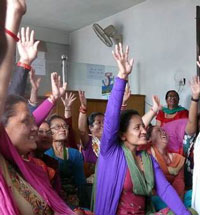 But the reverse is also possible: gender equality and sustainability can powerfully reinforce each other in alternative pathways. Women's knowledge, agency and collective action are often central to these, whether in managing local landscapes, adapting to climate change, producing and accessing food, or securing sustainable water, sanitation and energy services. We see this in examples where women are fully involved in forms of local forest governance that deliver both livelihood and conservation benefits, as Bina Agarwal has traced, and where networks of grass-roots women leaders are working to scale up capacity to reduce vulnerabilities to climate change in their communities.
For pathways to be truly sustainable and advance gender equality and the rights and capabilities of women and girls, those whose lives and well-being are at stake must be involved in leading the way, through community groups, women's organizations and other forms of collective action and engagement – supported by appropriate forms of investment and public services.
Women as 'sustainability saviours'? Beyond stereotypes to a relational view
However, a simple ‘win-win’ relationship between gender equality and sustainability cannot be assumed. Indeed, a policy focus on women can risk casting them as 'sustainability' saviours' in ways that stereotype their roles in relation to the family, the community and the environment. Such responses often add 'environment' to women's already heavy unpaid care and work burdens, without conferring rights, resources and benefits. Power imbalances in gender relations shape whether women's actions and work translate into the realization of their capabilities. And gender is always and everywhere cross-cut by other, intersecting power relations and inequalities, whether around class or ethnicity, age or place.
Hence analysis of interactions, tensions and trade-offs between different dimensions of gender relations and of sustainability is needed, along with attention to the structural foundations of gender discrimination and struggles against this. Recent policy attention to women and girls, from campaigning around the 'girl effect' to debates around the UK's Girl Summit earlier this year, while laudable in many respects, often lacks this relational perspective. Instead, women and girls are treated as individual victims, saviours or development beneficiaries in ways that may entrench stereotypes, while ultimately failing to empower. If goal 5 is to do its vital integrative work for the SDGs and the post-2015 agenda, then attention to gendered power relations, in all their rich, intersecting variety, must remain centre stage.
by Melissa Leach, Director, Institute of Development Studies
Find out more
UN Women: World Survey on the Role of Women in Economic Development 2014
The STEPS Centre's Pathways Approach: video, briefings and book
Pictures:
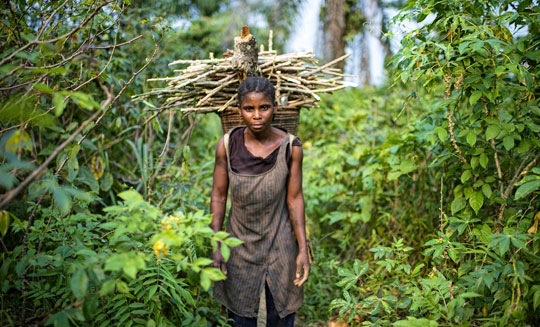
- Portraits of a woman, Lukolela, Democratic Republic of Congo, by Ollivier Girard (Flickr, cc-by-nc-nd)
- Women from Lumanti (Thankot, Nepal) participate in awareness raising session. Photo: OpenIdeo
Monday, 24 March 2014
Competing narratives on sustainable agriculture: what is the future that women want?

One view sees the expansion of commercial agriculture and high input agricultural value chains as the only way forward — a “green revolution” offering promising opportunities for smallholders to farm as a business. The other side passionately disagrees with this obsession with value chains and emphasises that agriculture is an activity intimately connected with the earth — ecological issues such as the long-term fertility of the soil cannot be ignored.
As this debate continued passed the parallel session where it emerged, what women themselves actually want became a central question. Women may not want to be driven into high value market chains. Women may instead want to achieve greater resiliency in food crop production for their families and communities under principles that preserve the long-term viability of their soil. On the other hand, a woman on poor, flood-prone land may prefer water-hungry sugarcane that will not be unpredictably destroyed, as her staple crops are all to often.
Proponents of opposing views may focus on different evidence and impressions. For example, a recent-meta study of organic compared to conventional yields published in Nature found that organic yields are 5% to 34% lower depending on the crop, management practices and soil (Seufert et al. 2012). Evidence such as this could be pointed to as a trade off between high productivity and environmental stewardship.
Advocates of the alternative stand behind the conclusions of the International Assessment of Agricultural Knowledge, Science and Technology for Development, a 3-year, multi-stakeholder, collaborative effort. The assessment strongly underscores that we must view “farming communities, farm households, and farmers as producers and managers of ecosystems.” [underlining in the original document] (Synthesis Report Summary, UNEP 2009).
This debate that surfaced calls on delegates to reflect: what is our definition of sustainable agriculture? Are there really two competing views here between maximizing yields and economic objectives versus care for the environment and local food production? Or is there a harmonious way to pursue multiple objectives? How do we listen to the voice small producers themselves, and especially women that provide much of the farm labour? How can people be empowered to make their own informed choices about what vision of agricultural investment suits their needs? These are all questions I would challenge all the sectors represented in this conference to explore honestly and in terms of practical considerations for how we invest in women and agriculture.
By Vera Rocca, Carleton University/Future Agricultures Consortium
Wednesday, 5 March 2014

Tuesday, 22 October 2013
Women and climate change: another special relationship?
 |
| Fishing community members, Zambia from theworldfishcenter's Flickr photostream (by-nc-nd) |
Further reading
- Okali, C. and Naess, L.O. (2013) Making Sense of Gender, Climate Change and Agriculture in sub-Saharan Africa Working Paper 57
Thursday, 21 March 2013
World Water Day 2013: What’s missing in MDG7 for women and girls?
By Lyla Mehta
Access to water and sanitation for all is central to achieving global justice for women and girls. 780 million people still lack access to drinking water, and sanitation remains seriously off track with 2.5 billion people lacking access to improved sanitation. Better access to water and sanitation facilities can reduce poverty and provide immediate health benefits for women and girls as well as better educational and economic opportunities and life chances. As debates on the MDGs – and what comes after them - abound, World Water Day 2013 offers a timely opportunity to look at the MDG goal on water and sanitation and what it means for gender justice.
Why do Water, Sanitation and Hygiene Matter?
Excess water in the household can be used by women for their kitchen gardens and can provide additional nutrition to diets, especially to children. Women and girls gain privacy and dignity through proper sanitation and menstrual hygiene facilities. It is now well known that poor sanitation facilities in schools prevent girls from attending school, especially during menstruation. Girls are also overburdened by time-consuming water collection activities. The lack of sanitation facilities exposes women and girls to violence and rape.
Water and Sanitation Targets: Achievements and barriers
Although the Millennium Declaration, adopted by 189 countries, was originally committed to issues concerning social justice and human rights, in reality the process that unfolded has largely been about tracking goals, targets and abstract numbers. This is also the case in water and sanitation where global declarations and targets often do not match with the on-the-ground realities of poor women and girls where at the local level a politics of power and control shape outcomes for poor people, especially poor women and girls.
Inadequate indicators and definitions
In March 2012, the world had met the water MDG of halving the proportion of people without sustainable access to safe drinking water, well in advance of the 2015 deadline. This was a cause for celebration. However, the measurement of progress is by averages, which say little about regional variations and variations between socio-economic groups or by gender. Largely, the poor in remote rural areas and informal urban settlements have been by-passed but they are the most deserving.
The MDG definition of ‘improved’ sources does nothing to address issues concerning water quality and issues concerning operation and maintenance of the service. It does not acknowledge the time taken for water collection activities and the acceptable distance walked is up to one kilometre! Cultural norms dictate that women and girls can spend between three minutes and three hours per day collecting water. (Is it right for rural women and girls to be spending so much time collecting water in the 21st century?) In order to avoid the long trudge, women and girls often compromise and may collect water from sources that are less clean which can have knock on effects on their health and that of their family.
Gender blindness has led to the MDGs ignoring critical issues relating to women’s interests at both macro and micro levels, including reproductive and sexual rights, and the importance of women’s access to land and productive water. The monitoring agencies all lack proper sex-disaggregated data making it impossible to monitor progress or devise gender sensitive policies. Data is essential if gender is considered to have any importance – to literally ‘count’.
Sanitation remains off track and there has been a tendency to ignore critical issues concerning sustainability. Constructing toilets does not ensure that they will be used, given prevailing socio-cultural norms and values. It is well known that in some parts of Africa, daughters-in-law will not use the same toilets as elder men and thus may require a separate facility. The targets and rewards systems that accompany sanitation programmes can often end up being a number counting exercise without ensuring long-term sustainability.
Looking forward
Even though water and sanitation were recognised as basic human rights in 2010 there is a considerable gap between rights talk and rights practice. Governments may not prioritise their national governments’ global commitments. Women’s participation in decision-making processes is often low and men continue to hold powerful positions in sector. Women’s presence is often a requirement of the implementing agency but it can often be tokenistic or women and girls are made to devote their voluntary labour rather than have any clear influence or develop particular skills. Gender and other markers of identities mould allocation and access among users. In India, lower caste women (Dalits) continue to be considered ‘impure’ and are excluded from participating in programmes and indeed in using shared facilities. Disabled women all over the world are often doubly disadvantaged. Accountability mechanisms for excluded women to demand their rights are weak throughout the world.
Current water and sanitation indicators to monitor progress are inadequate. They ignore gender dynamics, rights, equality, sustainability and equity concerns as well as regional variations. It is encouraging that the post-2015 consultations and different working groups are focussing on these issues. There are also discussions to address intra-household inequality through disaggregating data by gender, age, health status, disability. Whether these issues stay on the agenda until the very end, is of course, up for grabs.
If human rights are included, new targets and indicators will also be set but equality can be difficult to quantify. The new water and sanitation regime must avoid only focussing on the process of numbers and targets for these don’t capture the diversity of women’s choices and constraints and tell us little of local dynamics. Exclusion needs to be tackled head-on rather than to stop at the low-hanging fruit. Instead of asking who has gained access, we need to ask: who doesn’t have access and why? The strength of global action now needs to be measured in terms of rights, justice, inclusion and sustainability, as well as awareness of local contexts. This includes both local level action to higher-level ‘political will’ whilst drawing on and addressing the perspectives and interests of the poorest and most marginalised women.
This blog is based on a paper presented by Lyla Mehta at the 57th Session on the Commission on the Status of Women, New York, 6 March 2013.
Related links:
Commission on the Status of Women Session - including webcast
Shit Matters: The Potential of Community-Led Total Sanitation
STEPS Centre Water Domain
Subscribe to:
Posts (Atom)