Friday, 10 October 2014

Get involved! Your views on water and food security wanted by the UN

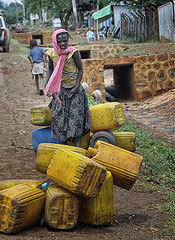
water-ethiopWould you like to help inform a report for the UN on food and water security? Now here is your chance. A year ago, the United Nations Committee on World Food Security (CFS) asked the High Level Panel of Experts on Food Security and Nutrition (HLPE) to prepare a report on Water and Food Security. Lyla Mehta, convenor of the STEPS Centre’s water and sanitation work, is the HLPR project team leader for the report, whose findings will feed into the CFS’s 42nd session meeting in 2015.

As part of the process, the HLPE is now seeking inputs, suggestions, comments on the ‘V0 Draft’ they have prepared, very much a work in progress document. This e-consultation will be used by the HLPE to further elaborate the report, which will then be submitted to external expert review, before finalization and approval by the HLPE Steering Committee.

To take part in the e-consultation, please visit the dedicated HLPE e-consultation website, or email your contribution direct to the HLPE Secretariat at cfs-hlpe@fao.org.

The e-consultation will run until 31st October 2014. Contributions are welcome in English, French and Spanish.

Monday, 6 October 2014

Recognising farmer innovation: the launch of the Phiri award

phiriOn October 24th at Barraza Pavilion in Tynwald in Harare, the Phiri award for farm and food innovators will be launched.

The award is named for Zephaniah Phiri, the renowned water harvester and ecological farmer from Zvishavane district, who is a long-time friend and inspiration to me. His innovations in wetland (vlei) farming over a fifty year period earned him first arrest and then national and international recognition. It's hoped that the Phiri Award for Farm and Food Innovators will open a new chapter in advancing indigenous innovation in Zimbabwe.

Just as Mr. Phiri discovered new ways to produce food abundantly and sustainably through detailed study and active management of the soils and hydrology of his land, so too are other dedicated Zimbabwean farmers making quiet breakthroughs that advance food sovereignty in their communities.

Just as Mr. Phiri shared his innovations with thousands of visitors from across the country, Africa and the world, so too can other local innovators be recognised and assisted to disseminate their innovations, technologies and sustainable farming practices. Just as Mr. Phiri's innovations – such as water infiltration pits in contour ridges and clay-lined ponds in vleis – are now adopted by tens of thousands of dryland farmers, so too can other innovations not yet recognised contribute nationally and beyond to the advancement of agro-ecological approaches to sustainable food systems.

Increasing recognition for local innovation and the creative capacity of food producers to solve deep problems and find new opportunities can help advance a partnership approach to agricultural development in which all knowledge is valued. This has a huge potential to sustain with dignity the central place of women and men who meet the food needs of their communities and the country.

The Phiri Award is a new programme, whose trustees are drawn from leading Zimbabwean institutions. The Trust is chaired by Professor Mandivamba Rukuni. Working with national networks, local government and grassroots groups, the Trust gathers nominations from across the country; coordinates visits to selected farmers and others during their growing and harvesting season; documents their innovations; and organises the annual Award ceremony.

As with Mr Phiri, the award winning innovators will have relied on their own resources and energies to develop their practices, and will often have struggled for many years to gain recognition for their work. They will come from small-scale farming communities or marginalised backgrounds in urban settings. From creativity in the face of hardship, they will have developed proven new approaches that others have now begun to adopt and adapt.

So if you are anywhere near Harare (the venue is 15 mins from town by car) on October 24th, come and meet the 2014 award winners, and of course Mr Phiri himself, along with the Trustees and many others. Just let the organisers know (email below).

Thanks to John Wilson (secretary and acting coordinator of the Trust) and Ken Wilson (trustee) for this information (and most of text for the blog!). To contact the Phiri Award and register your attendance at the launch, please email: phiriaward@gmail.com

This post was written by Ian Scoones and originally appeared on Zimbabweland

Thursday, 2 October 2014

A Fork in the Road in Implementation Research: Swerving towards people centeredness

Mistakes are guaranteed. Learning from mistakes is not guaranteed. Implementation research is an attempt to maximize the chance to learn from our own and others' mistakes. Several forces array against successful learning from mistakes:
  1. Mistakes create benefits to small groups who will fight attempts to detect or correct them.
  2. Mistakes embarrass the leaders because infallibility is mistakenly presumed to be a leader's birthright.
  3. Mistake detection is an extra expense, and dollars spent to monitor don't obviously save lives the way direct services do.
Health systems researchers face a fork in the road. One path leads to implementation research as big science which can anoint a priestly caste of implementation experts pursuing universal truths and codifying best practices in mistake correction. The experts' business model is to sell expertise to clients and research foundations.

Another path leads to implementation research as small science — a cottage industry practiced by every district health officer, clinic manager, and MoH official. As small science, implementation research would become a widely prevalent skill in systematic and organized mistake detection. Everybody has to muddle through. Some keep repeating the same mistakes. There is a better way to muddle through, and we need health system functionaries at all levels to be experts at mistake detection and correction. The forces that perpetuate mistakes need to be engaged on local battlefronts one small sub-district, province, or ministry at a time.

The crucial choice for implementation research is whether it is to be identified as an epic search for universal solutions or as a platform to spread established methods of finding local solutions. The proliferation of self-identified global health experts and an organization calling itself "Health Systems Global" speaks to the seduction of searching for universal solutions. The latest seduction has been systems science. Many, myself included, have approached the construction of health systems models and simulations as a search for distilling eternal truths about health systems. After the "Eureka moment" the systems scientist announces a new universal principle and thereby changes the world. Right? Wrong!

What follows is the predictable disjunction between the researchers' distilled knowledge and implementation. Shortcomings in the small, local manifestation of policy research are a prevalent block to big science implementation research. For a discipline committed to mistake detection it would be unseemly for implementation research to perpetuate the myth that global decontextualized knowledge is readily recontextualized. This is not a false dichotomy, it is a real one. The more we push a paradigm that implementation research is the province of rigorous scholarship, the more we disable practitioners from accessing readily available approaches to doing their jobs better.

There is a different version of implementation research called participatory modeling, and even if some doubt how participatory the approach truly is, it is at least designed to engage the implementers themselves from the very beginning of the problem solving journey. A partnership forms where stakeholders and systems scientists convene to use the symbolic tools to identify and diagram the way a small system of interest to a planner can support the implementation of new policies.

A shared understanding of how organizations work can focus attention on where mistakes should be anticipated and how system reforms may lead to other mistakes. Here, implementation research is more a practice of mindful implementation. Indeed it is a style of managing one's implementation using practical research than it is a quest for universal principles.

To embark on the pathway to spread implementation research as a practical learning technique to be practiced broadly will rain on the ambitions of many would-be heroes of global health knowledge. Don't fear, they won't go away. Proof that big ambitious policy research is inert doesn't seem to slow it down. Luckily the evidence that building universal capacity in small and local systems thinking helps change policy for the better does appear to be leading to enthusiasm and growth.

Miraculously, there is a groundswell of interest in taking the small narrow road to powerful ignominy rather than the broad glorious road to powerless notoriety. More and more health systems researchers are focusing on moving skills in mistake detection and mistake correction closer to the people affected by mistakes. This approach epitomizes people centeredness. It can involve people in an ongoing cycle of vigilance to make their local health policies autonomously mistake-correcting.

Academicians who feel threatened by turning over control and authority to the people affected will object that deep complexity of health systems requires brainiacs and super computers. These guys don't get it. The utopian health system guided by global best practices is a pipe dream.

What is in our reach are real health systems everywhere in which more people are more involved in mistake detection and correction. The spread of the practice of small, local implementation research can spread the word on the necessity of people's involvement and watchful scrutiny every time one implements. This is a radical idea, powered by truth. It is exciting to see health systems researchers shed laurels and roll up sleeves to share the word that everyone makes mistakes and everyone should work on fixing them. This is the future of implementation research.

By David Bishai, Professor, Johns Hopkins Bloomberg School of Public Health  

Research methods for people-centred health systems: Social network analysis

As the first two plenary sessions have already highlighted, the focus of the Third Global Symposium on Health Systems Research here in Cape Town, South Africa, is on people-centred health systems. For FHS, which has unlocking community capabilities as a core theme, this is a welcome focus.

But if we're focusing on people-centred health systems, what are the implications for research? We've been exploring a number of methodologies during our research that we will be highlighting throughout the symposium.

For today, the focus is on social network analysis, or SNA.

A bit about social network analysis
SNA allows for identifying and measuring relationships and connections among people, organisations, or other units. By modelling communication, funding, and other pathways among, within, and between people and groups of people, researchers can understand the diffusion of knowledge and innovation, as well as the formation of new relationships over time. In a complex system, social network analysis can also support system conceptualisation.

A social network analysis comprises of a number of nodes, or people, connected by a relationship. This link is known as an edge. SNAs are often visualised in a network map, and network scientists have devised a number of mathematical functions to help describe networks. Often, there is a focus on the density of a network (how many connections individual nodes have), and finding how central a certain node is within a network.

How were using SNA in our research
As part of the FHS India team's in-depth look into the state of maternal and child health services in the Indian Sundarbans of West Bengal, they have done an SNA study examining the social networks of mothers in two remote villages.

In these villages, a number of the men out-migrate to the nearest big city, usually Kolkata, for work. The SNA purposively selected a group of mothers with migrant husbands and another group of mothers whose husbands remained in the community to compare the networks. The SNA has evaluated support networks for cognitive, financial and material support to the mothers. The research brief is forthcoming.

Getting hands on with SNA
At the Third Global Symposium on Health Systems Research, in collaboration with Jess Shearer, we will be undertaking a participatory social network analysis (she will be presenting a detailed analysis at her session on Friday, 3 October between 11:30-13:00 in room 1.61-62). All members of Health Systems Global are invited to take the survey -- either at Stand 56 or online. We're looking at the social, collaborative and information networks of HSG members.

We've been using Google FusionTables to make the network map. Here's a snapshot of the HSG social network.

By Jeff Knezovich, FHS Policy Influence and Research Uptake Manager, Institute of Development Studies

STEPS Centre's Adrian Smith on grassroots prototyping at SCORAI Europe

Adrian Smith, STEPS Grassroots Innovation project convenor, will talk about grassroots prototyping past and present to a SCORAI (Europe) workshop on sustainable consumption at Kingston University today.

The flourishing of community-based workshops for prototyping new forms of production and consumption using versatile digital design and fabrication technologies can learn from similar community workshops in the past. Experiences with Technology Networks in London in the early 1980s, for example, points to how important are matters of material culture, social movements, and political economy are to these workshops.

The presentation draws on SPRU/STEPS research on grassroots innovation, particularly grassroots digital fabrication.

For more information about the workshop, see the event page (Kingston University website).

Further reading
Two SPRU Working papers and a STEPS Working paper relate to the work: