Monday, 23 June 2014

The nexus needs research across disciplines – but how?

STEPS co-director Andy Stirling addresses the challenges of working across disciplines in a new blogpost for the Guardian. The ‘nexus’ is the latest buzzword intended to lure researchers out of their disciplinary comfort zones and get them working together on the big challenges of the day. But how easy is it in practice?

There is a crucial distinction between multidisciplinarity and interdisciplinarity. Both seek to transcend narrow agendas, but true interdisciplinary research is designed to go beyond particular theoretical prejudices, privileged methods or favourite solutions – important in the face of big, interconnected challenges like water, energy and food.

The barriers to achieving this include organisational structures within research institutions, the reinforcing power of metrics, citation counts and the Research Excellence Framework (REF). Social science – which examines not only at the ways in which resources and systems are managed and changed, but also the way knowledge is framed and constituted – plays an important role in the search for interdisciplinarity.

Read the full piece:

Friday, 20 June 2014

Is the health system response out of sync with the demands of the islanders in the Indian Sundarbans?

Five years ago, a mid-summer nightmare named Aila crashed on the Sundarbans with murderous fury and wreaked destruction beyond repair. On May 25, 2009 the tropical cyclone hit the Sundarbans in India and Bangladesh with a wind speed of 110 km/hr. Over 8,000 people went missing and more than a million were rendered homeless in the two countries. In India about 300 people were killed in Sagar Island alone in the Indian Sundarbans. Figures can scarcely do justice to record the number of homes destroyed, lives lost and livelihoods decimated.

There was a localised health system collapse in the immediate aftermath of Aila – a fact attested by the islanders loudly and by the state health policy makers privately.
Nearness to the state capital Kolkata has been a boon to doctors sent out to the public health facilities in the Sundarbans and a bane to the islanders. Most of the government doctors take it as a day job for four hours and openly flout the government norms. It was -- and still is -- the best known secret in the islands.

The suddenness of Aila left the state health machinery and the 'day doctors' out of reach of the islanders for close to a week. For seven days after Aila, the medical team camped in the landlocked part of the Sundarbans, leaving the islands at the mercy of a few 'braveheart' state doctors and village 'doctors' (or Rural Medical Practitioners, RMPs). Even traversing all the landlocked areas was difficult as the roads were 'sealed off' by the trees uprooted by the cyclone. And this was for the all-weather metal roads. For the rest they were left to their own peril.

When the state could get the doctors to reach their stations they were confronted with overwhelming numbers of water borne diseases that poured into the government as well as the NGO health facilities. Ironically, the health response saw the RMPs and the state doctors working hand-in-hand to tackle the huge case load.

The state health system response, or the lack of it, has taken a toll on the mind space of the islanders who, as the FHS studies would later suggest, have veered more towards the RMPs.


"Nearly 85 per cent of the children of the region could not be taken to the hospital or to a qualified doctor in the event of sickness and were treated by unqualified and untrained Rural Medical Practitioners (RMPs)."


FHS India's How Healthy are the Children of Indian Sundarbans found out – five years after Aila – that nearly 85 per cent of the children of the region could not be taken to the hospital or to a qualified doctor in the event of sickness and were treated by unqualified and untrained Rural Medical Practitioners (RMPs). Aila has irreparably damaged livelihoods – by rendering farmlands unusable, by contaminating fresh water ponds, by drowning families in debt – to such an extent that many villages are now bereft of men. So when a child falls ill, it falls upon the mother or grandmother to take it to the doctor. And it is well-nigh impossible for a woman to carry an ailing child to the block hospital, which may be a several hours by land and boat away from her home.

Hence the dependence on the RMPs, who, though offering care of a dubious quality, invariably have chambers in the heart of the villages, are always available and willing to provide medicines and treatment on credit. Tellingly, a 2010 study by Future Health Systems revealed a significant switch in people's dependence on RMPs vis-à-vis the Aila – about 83 per cent of ailing children in Patharpratima were treated by the RMPs one year after Aila compared to 67 per cent in the pre-Aila year. The How Healthy are the Children of Indian Sundarbans report not only suggests that the absolute dependence on RMPs is a major factor behind the miserable health condition of the children of the Sunderbans but also that the Aila has contributed greatly to this pernicious dependence.
 
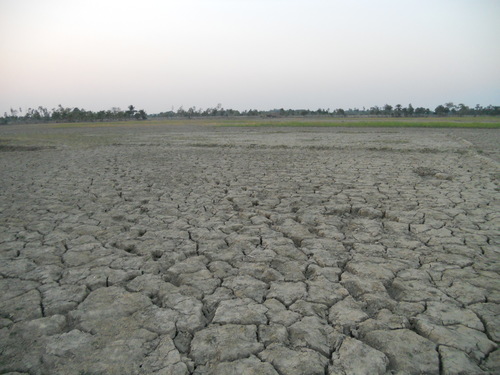
Many of the fields that were abundant before Aila are now barren due to salinity.
The Sundarbans islanders – since the time they have settled down – have been up against two constant disadvantages: a difficult geography and an uncertain climate. Post-Aila, the people had additionally to contend with the uncertainty of the politics born of a regime change. The social and health security schemes are being increasingly marred by politics making the health system of Sundarbans susceptible to any future climate shocks – both big and small.

After the cyclone, five years down the line, as the successive FHS studies reveal, there has been a positive change in the overall health status of the people in the last 10 years. The disturbing peck in this otherwise rosy image is that there has been an increase in climate sensitive diseases like diarrhea and acute respiratory infections (ARI) amongst children. How much of this positive turn in the overall health seeking status can be attributed to the responsive health system and how much it is due to the community's awareness and individual effort to seek care from outside the Sundarbans, though, is a matter of debate and further research.

How indelible is the mark that Aila has left? FHS researchers' interactions with the people, particularly in the course of its study, of the vulnerable groups reveal a different and disturbing picture. Self-reported morbidity of women is significantly on the increase. For the women in the islands, doubly burdened with household chores and stressful livelihood in the absence of their seasonal migrant husbands, the reasons are not hard to imagine. Long periods of wading through waist deep saline water make them more susceptible to vaginal infection and body ache. Mental illness in a phobic situation of uncertain future is now very common in the Sundarbans. Dr. Amitava Chowdhury, the definitive lens which had informed the Amitabh Ghosh's 'Hungry Tide' and who is treating patients for more than 20 years in the islands of the Sundarbans, asserts that the health of islanders is steadily going downhill post Aila:
'I get increasing number of cerebral palsy among children… and also most women seldom weigh more than 40 kg. This, I am sure, is due to lack of nutrition and the general atmosphere of uncertainty and depression post Aila'.
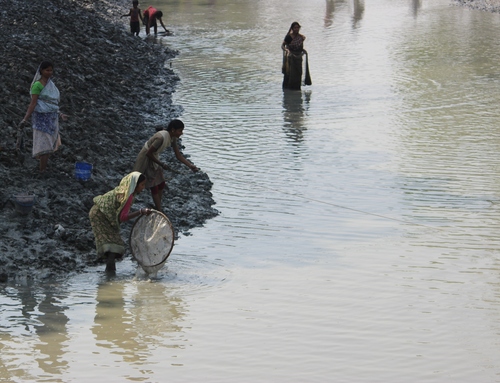
With many of the men having migrated out of the Sundarbans for work, there is a significant burden on local women, who must find safe drinking water, get food, and take care of their own and their family's health. Here a group of women are fishing for their livelihoods.
With many of the men having migrated out of the Sundarbans for work, there is a significant burden
on local women, who must find safe drinking water, get food, and take care of their own and their
family's health. Here a group of women are fishing for their livelihoods.

The situation is compounded by absence of potable water, arsenic contamination and high rate of open defecation in Sundarbans. The availability and acceptability of health schemes have been severely marred by political bias towards selected sections of the population. Political polarisation has complicated the already complex social determinants of accessing health system like physical access, economic access and social access.
 
In a nutshell, how has the health system responded? If one goes by the WHO guideline of 'a well-functioning health system responds in a balanced way to a population's needs and expectations by: improving the health status of individuals; families and communities defending the population against what threatens its health; protecting people against the financial consequences of ill-health; providing equitable access to people-centered care; making it possible for people to participate in decisions affecting their health and health system' – five years after the fateful Aila equitable access to the health system still remains a distant dream for the majority of the Sundarbans islanders.

By Shibaji Bose, FHS India Policy Influence and Research Uptake Officer

GM crops: what people in the global South really think


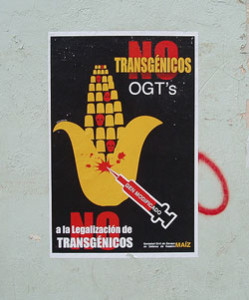
maize poster
GMO maiz by nolosabias on Flickr
(cc-by-nc-nd)
Durham University has just published an important new research report on the governance of transgenic crops in three of the world’s ‘rising powers’ – Brazil, Mexico and India – looking at how different groups in those countries have reacted to GM crops.

The document, A new approach to governing GM crops? Global lessons from the rising powers, was launched during an interesting discussion workshop at the Royal Society’s premises in London on Friday 13 June.

If you’ve kept half an eye on public debates and media reporting about transgenic crop issues over the last decade, you may well have received the impression that farmers and publics in several ‘developing’ countries have embraced GM crops and foods. After all, transgenic crops such as soybeans, cotton and maize are being grown by numerous farmers, including small-scale cultivators, in populous low- and middle-income nations such as China, India, Brazil, South Africa, Pakistan, and a handful of others.

More than a few commentators have suggested that these countries’ openness to transgenic crop technologies puts the ‘selfish’ and ‘irrational’ anxieties of affluent European consumers into a shameful perspective. Unlike the well-fed Europeans, goes this argument, impoverished cultivators and hungry consumers in the global South cannot afford to turn up their noses at this vital, safe and productive technology.

Testing the narrative
The Durham University research used an innovative combination of social science research methods to put this narrative to the test. The project was carried out in collaboration with a team of academics from the countries concerned, and funded by the John Templeton Foundation, a philanthropic donor that likes to invest in the study of big social, philosophical and scientific questions.

The researchers spent time observing, interviewing and discussing GM crop issues with national scientists, groups of small-scale farmers and urban consumers in each of the three countries, culminating in deliberative workshops that brought these diverse groups and other stakeholders together.

The researchers found that the spread of GM crop cultivation did not necessarily mean that farmers and consumers were all completely comfortable or satisfied with the technology. In fact, transgenic crop technologies have proved quite controversial, and unpopular with some stakeholders in all three of the focus countries.

Both growers and consumers said that they felt ill-informed about the technology, its environmental and socio-economic implications, and its prevalence in agriculture and the food system. They felt excluded from decision-making and suspected the motives of agribusiness companies, entrepreneurs, large-scale farmers, politicians, and regulators.

Differences
Scientific experts were more likely to dismiss public concerns and argued that the development and deployment of transgenic technologies was rightfully an urgent priority for the sake of national prestige, scientific competitiveness, economic development, and food security.

Yet in some cases, younger scientists were more likely to have reservations about the necessity and benefits of genetic modification. They worried about ecological effects and sustainability, and did not necessarily share the confidence of previous generations in the inevitability of achieving social and economic progress through modern technology.

The researchers also identified interesting differences between Brazil, Mexico and India. For instance, it is quite widely known that maize (corn) occupies a central place in the cultural traditions and identity of Mexicans, but soybeans in Brazil are an introduced crop without traditional culinary associations, which is produced largely for animal feed or for export.

Cotton in India is an intermediate case – a non-food crop whose history is, nevertheless, intimately linked with that country’s experience of colonial exploitation. Differences like these help to explain why national controversies over genetic modification have followed different paths.

A breakdown in trust
For me, one of the report’s most troubling observations was of a pervasive breakdown in public trust in institutions of science, governance and regulation. This is especially troubling with regard to small-scale farmers’ lack of confidence in the scientists and technical advisors of the agricultural extension services, agro-dealers and seed companies, who should be helping them to solve their farming problems.

When agricultural technicians and farmers freely blame one another for problems that are beginning to appear in transgenic cropping systems (such as pest resistance and herbicide-tolerant weeds), and neither accepts responsibility for their part, we have evidence of a serious breakdown in a key relationship that should be helping to improve the productivity and sustainability of agriculture around the world.

New forms of governance
The Durham-led research team intends to build on the insights from this research in various ways. One of these ways is towards the practical goal of building better institutions for the governance of controversial technologies, using the ‘AIRR framework’.

AIRR stands for four dimensions of ‘responsible innovation’: anticipation of future developments in science and technology; inclusion of diverse stakeholders; reflexivity among scientists and technology developers; and responsiveness to societal needs and problems.

This framework has a lot in common with elements of the STEPS Centre pathways approach, which calls for the opening up and broadening out of public debates and governance frameworks for new technologies.

If the Durham report achieves the impact it deserves, it will achieve a valuable purpose by internationalising narrow British and European public debates about transgenic crops and foods, and about the relationship between agricultural technoscience and socio-economic development. It will undermine the complacent assumption that the ‘rising powers’ have definitively resolved the controversy over transgenic crops and that the future will see them inevitably race ahead in embracing GM technology.

Links

16 June: China and Brazil in African agriculture - news roundup

CBAAnewsThis news roundup has been collected on behalf of the China and Brazil in African Agriculture CBAA) project.

For regular updates from the project, sign up to the CBAA newsletter

‘Estimating China’s Foreign Aid 2001-2013’
A new working paper by Naohiro Kitano and Yuiknori Harada at JICA has published revised estimates of China’s current aid disbursements. However, they have also presented the data in such a way that it allows a direct comparison with ODA net disbursements according to DAC definitions which has not been done before. The results suggest that net aid totalled $7.1bn in 2013 and that if placed within the list of DAC countries, then China moved from being the 16th biggest donor in 2001, to the 6th biggest donor in 2013. The results are based upon mixture of publically available data and informed estimates.
Forthcoming Brazil-Africa agricultural research agenda publishedThe Agricultural Innovation MKTPlace programme that forms research collaborations between African institutions and Brazil (usually EMBRAPA) has published the preliminary list of research projects and partnerships for the coming year.
(Agricultural Innovation MKTPlace)

Brazilian support for small-scale farming in Africa
Brazil’s ambassador to Ethiopia claims that the PAA programme (Purchase from Africans for Africa / Programa de Aquisição de Alimentos) been successful for smallholder farmers in the 5 countries it currently operates in: Ethiopia, Mozambique, Malawi, Niger and Senegal. She announced that there were plans to expand the programme in Ethiopia, which currently operates mainly in the south of the country.
(AllAfrica)

Chinese agricultural engagements in Mozambique
The Chinese news agency Xinhua has published a series of articles on Chinese engagements in Mozambican agriculture. They all report successes of Chinese projects in the region and two of the articles cite Sergio Chichava, a partner on our research project.
China-Africa blog
Li Xiaoyun, Richard Carey and Yunnan Chen have published a blog on ‘China-Africa cooperation and the modernisation of a continent’. It puts forward that China’s planned infrastructure developments on the continent are a form of public entrepreneurship that will serve to modernise the continent. They also argue that China is proving its commitment to Africa’s economic growth by the size of its investments of money and peacekeeping troops but that a convergence of agendas between China and its African partners will be needed for greater success.
(IDS Globalisation and Development blog)

Large-scale vs. Small-scale farming in China
This blog article looks at the debates currently going on in China between those advocating large-scale farming and those highlighting its problems. The blog also presents studies that argue there is relatively little difference in yields and costs between the two sizes of farms. It would be interesting to see whether these debates also take place with respect to the farming models being exported by Chinese institutions to Africa.
(Dim Sums)
Is the World Bank facilitating land grabs?
In a publication called ‘Wilful Blindness’, 180 organisations comprised of unions, farmers and consumer groups, and NGOs have called on the World Bank to stop publishing its ‘Doing Business Rankings’ as they argue this has facilitated foreign land grabs and thereby damaged local communities.
Brazil and China partnerships on Mozambican hydropower plant
Mozambique is planning to build a new hydropower plant on the Zambezi river with transmission lines connecting Tete to the South Africa Power Pool. The project is to be developed as a public-private partnership involving the China Development Bank and the State Grid Company of China as the main shareholders and financiers of the project. Electrobras of Brazil will also be a minority shareholder.
By Henry Tugendhat

Monday, 16 June 2014

Sustainable intensification: a new buzzword to feed the world?

The term 'sustainable intensification' (SI) has entered academic and policy discourse in recent years, including in debates about what to do about agriculture in Zimbabwe. I have been intrigued for some while to find out what it actually means. Is this yet another contradictory hyphenation of two words for political ends, or does it have some substance? Who is driving this debate, and what does it mean for Africa?

A flurry of publications have been produced in the past year or two that use the term, and they provide a good route to finding out a bit more. A high profile article in Science from 2013 offered a definition of SI: "to increase food production from existing farmland in ways that place far less pressure on the environment and that do not undermine our capacity to continue producing food in the future". The major Montpellier Panel report offer a similar one, defining SI as "producing more outputs with more efficient use of all inputs on a durable basis, while reducing environmental damage and building resilience, natural capital and the flow of environmental services". Other similar formulations appear in a recent Royal Society collection of papers. No one could disagree with these it seems. Is SI then just what we used to call sustainable agriculture, or is there something more to it?

To answer this, we have to probe a bit further and ask what analytical frameworks underpin the concept and its definition, and what policy narratives flow from it? The Science article, and the Oxford Martin School report which preceded it, situate the challenge in terms of the familiar argument about resource scarcity – of land, water, and resources – in relation to a growing population of 9 billion needing to be fed. This justifies a 'crisis narrative' argument that pushes towards a productivist response: more food is needed on less land with less water, requiring new technologies to deliver it.

The challenge is often couched in the well-used metaphor of the 'perfect storm', memorably used by the former Chief Scientist in the UK to argue for a global response to impending food shortages, in the build up to the oft-cited 2011 UK Foresight report. In recent years a new version of this narrative, with a new word, has emerged. This is now portrayed as the challenge of 'the nexus', where multiple resource constraints come together requiring a particular style of (usually) technical, top-down response.

While no one would argue against improving resource use efficiency and boosting production in sustainable ways, it is the link between this technical challenge and the wider framing of the problem and solution where issues arise. These have been outlined in a recent paper on land issues that I co-authored, but the same arguments could be applied to other resources, and the challenges of agriculture in Africa more generally.
  • First, we must be careful when proclaiming generic resource scarcity as the driving force for action. My scarcity may be someone else's surplus: scarcities are always relative, and resource access and distribution is a crucial issue that is not addressed by this narrative.
  • Second, because scarcities are constructed in policy arenas, there is a political dimension that must be acknowledged. So-called 'global' scarcities are very often the consequence of high unequal power relations, skewed consumption patterns and poor resource governance.
  • Third, a solely technical response through increasing production or efficiency in ways that conserve the environment – often laden with yet more jargon such as 'climate-smart agriculture' or 'conservation agriculture' – ignores the social and political choices around technology and its direction. A crisis narrative that forces a particular trajectory may restrict debate about alternative choices, and debates about pros, cons, risks and rewards. A good case in point is the promotion of GM crops by certain large corporations in terms of 'sustainable intensification' (see last week’s blog).
The advocates of SI are quick to point out that their approach does not promote any particular technology over another. Various declarations reiterate this, and a recent Royal Society publication offers a huge array of different technological solutions under the SI banner. The Montpellier Panel, a group of well-known agriculture experts, are even more explicit. They point out the potential for capture of the term and its politicisation:

"the term "Sustainable Intensification" –– has come to take on a highly charged and politicised meaning, becoming synonymous with big, industrial agriculture. As we strive to feed a population expected to reach nine billion by 2050 sustainably, the risk is that we may lose sight of the term's scientific value and its potential relevance to all types of agricultural systems, including for smallholder farmers in Africa"

Equally, the Oxford report argues for the need to "deepen and extend understanding of systems interactions", to "consider and define what specific goals societies wish agricultural production to achieve" and to "develop metrics that will enable societies to measure progress in achieving them". All good stuff, resonant with long running debates about sustainable agriculture, and discussions on the politics and direction of innovation outlined in the STEPS New Manifesto on innovation, sustainability and development.

Yet in all this warm-sounding rhetoric there is an absence of social and political analysis that undermines the approach. In the late 1980s I joined the recently formed 'Sustainable Agriculture Group' at the International Institute of Environment and Development, together with Gordon Conway and Jules Pretty. Our approach to agricultural sustainability was in many ways strikingly similar to the current debate about SI. But with one important difference: people and their livelihoods were central. Our work evolved in concert with debates about 'sustainable livelihoods' and participatory approaches to development, and had as a result a very different flavour.

Looking at the long lists of authors of papers and reports on SI there are, beyond a scattering of economists, vanishingly few social scientists involved. This is telling, and reflective of the sometimes naïve perspectives portrayed, about the political and social contexts of these debates. Frequently, a techno-economic determinism dominates, driven of course by a passion and commitment to addressing major challenges, but without the necessary social and policy analysis to make it happen, and avoid it being captured.

Take the diagrammatic representations of the approach by the Montpellier Panel. Here 'farmers' and 'communities' are put at the centre, but all the action happens around them, seemingly disconnected. Agrodealers represent the market, but the process of sustainable intensification seems to be driven by a technical process. It is all well and good arguing that societal goals are defined, as the Oxford report does, but how can this happen, through what political process? In the terms of the New Manifesto, how are innovation directions set, how are the diversity of options defined, and how are the costs and benefits distributed? These are issues that seem not to be on the table, or at least not in ways that are central.

If SI is to have any meaning beyond a seemingly uncontroversial, hyphenated buzzword, then these are the questions that must be put centre stage. For SI to be anything more than a rather odd collection of technical solutions, then questions of socio-technical choice and direction must be put at the forefront. This means having a political debate, and bringing in people more centrally, something that may jar with the rather bland techno-economic prescriptions offered to date. 

This post was written by Ian Scoones and originally appeared on Zimbabweland